
We've talked victory
conditions and knowing
your limits, and even a bit on when it's okay to just
go crazy. Today, I'm going to talk about how to allocate
resources.
In some team environments, one player
determines who gets what resource over the course of a game. In
others, it's simply first come, first serve. Maybe it depends on the
situation. Maybe it depends on the victory conditions. But
regardless, knowing what qualifies as a resource and how to determine
who gets it is an important aspect of shot-calling.
Since the majority of my audience are
Halo players, I'll address the context of resources in Halo first.
What are the resources in Halo?
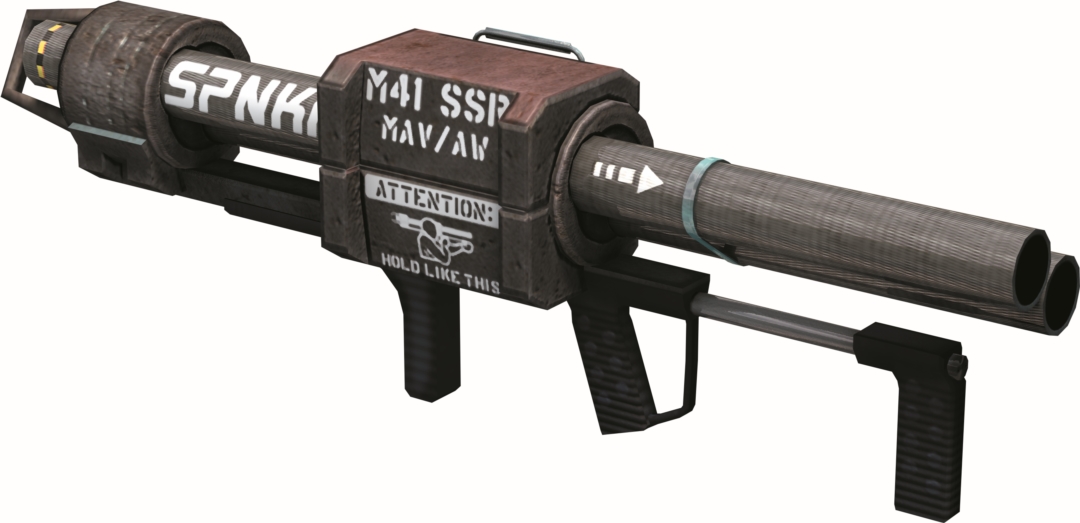
If you're playing
along at home, your first reaction was probably “POWER WEAPONS!”
And congratulations, you got the #1 answer on the board. But power
weapons aren't the only resource in Halo.
Map objectives are
another obvious resource. Whether it's Oddball, Hill time, the Flag,
the Bomb. Someone says “Hey, take hill.” He's allocating a
resource.
But from there,
what qualifies as a resource becomes a lot more subtle. I'll make a
bulleted list.
- Power Weapons
- Objectives
- Power Positions
- What? How can a position be a resource!? Power positions are important areas of the map which offer escape routes, sightlines, and combat advantages. But you don't want everyone to be in the power positions. Some players have to keep moving, pushing for objective, cutting off pushes, flushing out players, et cetera. Determining who gets to stay in the power position is allocating a resource.
- Help
- Other players responding to your call-outs, pushing behind you, or watching your sightlines are a resource. Your teammates are a resource. Who they decide to work with on a moment-to-moment basis determines who receives that resource.
- As an example of a team that uses this, listen to Towey coach Evil Geniuses. Often, he will tell a player who has just spawned to “Go help x” – he's allocating the resource for the team and ensuring a player isn't left stranded on the enemy side.
- Communication
- Even call-outs are a resource. Because it's hard to hear when players talk over one another, it's important to make sure communication is streamlined. A player on the opposite side of the map from teammates should not be trying to talk over those who need to communicate their plans to work together (unless it is pertinent information to those three.) An isolated player making callouts of players his teammates have no possible way to see is flooding a resource, giving information that isn't valuable or useful.
- Ammo
- Apart from literally being a resource for your guns, ammo is a resource that sometimes has to be discussed among the team. In stalemate situations (especially H2A's Lockdown TS), a player with a Sniper may not need their Battle Rifle ammo, while his teammates need it for trading or creating shield advantages to set up a push. Allocating weapon ammo among teammates to ensure everyone is combat capable can be the difference between winning or losing a stalemate situation's resolution.
As
you can see, there are actually several resources in Halo that need
to be split up among the team. Knowing who needs to receive what
resource at what time, or who should forego a resource to do
something else (such as pushing up and letting the next player to
spawn grab a power weapon on your side), are key to shot-calling
toward victory.
What
are the resources in LoL?
In
League of Legends, there are even more resources to track. Many are
less nuanced than in Halo, so I'll keep my bulleted list a bit more
concise:
- Gold (minion waves, tower gold, assists)
- Experience (minion waves)
- Farm (jungle)
- Ganks (or pressure from a teammate's presence in general)
- Vision (where your wards are)
- Vision denial (where you clear enemy wards, who gets the ward kill)
- Summoner spells (how many do you expend for a kill)
- Abilities (especially ults, how many do you expend for a kill / to save someone / who do you use them on in a team fight)
- Buffs (red/blue/abilities)
- Globals (TP pressure, global range ultimate pressure)
- Wave control (what waves you set up to slow push, what waves you just flash farm)
Much
of LoL strategy revolves around power spikes and funneling farm into
specific players. Whether it's to get them to their power spike
sooner, or to get them into a state to counter an enemy power spike,
you want to make sure farm goes where it's needed. Experience comes
with farm. Who do you try to make sure stays ahead in levels? Do
you sacrifice EXP on your support/jungler and rely on team fights /
skirmishes to catapult them back with the catch-up mechanics of the
game?
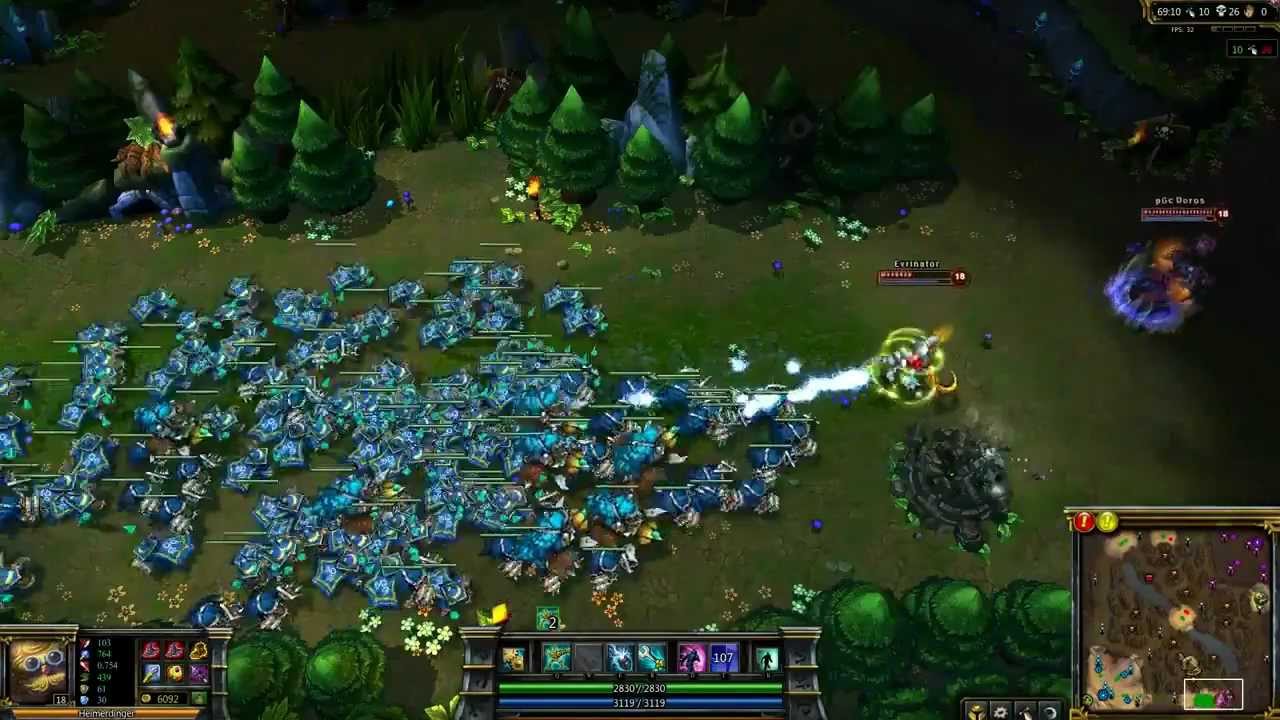
Ganks
and jungle pressure can determine the outcome of a lane. Determining
who gets said ganks may depend on champion match-up, skill match-up,
or the opponent's priorities. As a shotcaller, you have to know who
needs pressure when.
Expending
too many summoner spells (or long cooldown ultimates) for a gank can
leave you vulnerable for a long period of time. If you're planning a
gank 90 seconds before Dragon, do you all flash to finish the kill
and the moderate gold spike? Or, do you let him live, knowing you'll
need those flashes for the potential team fight at Dragon? Those
flashes could mean a tower kill. Or, if you're out of sync with the
team, one flash could mean the play gets turned around. Before the
play is made, the shotcaller should make it clear if you're burning
summoners and ultimates or not.
Vision
needs to be rotated depending on your current focus on the map. Pink
wards are not meant to stay in the same place all game. They need to
be moved to ensure zones of denial or longer lasting vision. Deep
wards need to be placed to know what's coming in a situation.
Sometimes, placing deep wards can be risky and requires the escort of
your jungler as a support to get the wards down. (Note KT Rolster,
or last season's Samsung White often having Score+Piccaboo or
Dandy+Mata respectively synchronizing their backs and duo-invading
early on to ensure they can get wards down together.)
In
both games, it's important to be able to identify your resources and
determine where they need to go. A good shotcaller must gauge who
needs what when.
If
you're struggling to determine how to allocate resources, ask
yourself some questions when faced with a decision:
- What are the victory conditions right now?
- Who is important to fuel our path to victory?
- Who is closest to the resource?
- Do they need it?
- Will we lose anything if x goes for this resource?
- Is it worth it?
- Who else could take it instead?
- Are we transparent in our resource allocation?
- Can/Will our opponents try to counter it?
- Can we deny our opponents' resources?
- X doesn't have the resources they should, do we sacrifice them and put resources elsewhere?
- Or do we sacrifice elsewhere to put resources on them?
- Which path is safer?
Obviously
you can't ask yourself these questions each and every time a decision
arrives. These are just an exercise to improve. As you improve,
you'll find yourself giving better valuation and distribution
naturally. As you begin to efficiently distribute resources in a
game, you will find yourself with more advantages and leads to press
in a game.
That's
all for this relatively short bit. Part 5 will be a bit delayed, but
I'll discuss how to identify less apparent advantages in order to
determine when you have a lead or the ability to create a lead out of
a mismatch.
