Showing posts with label halo 2. Show all posts

Saturday, September 12, 2015

Audley's Workshop: Lockout Reforged

Lockout is one of the most polarizing maps in terms of fan perception. Some love it, some hate it. Very few neutral opinions exist about the map. Still, it is one of the most played maps in Halo history.

However, just because something is the most played does not make it the best. And in Lockout's case, the map had plenty of design issues that contributed to the hatred it received from those who did not enjoy.


Starting off by speaking of the pure default vanilla slayer settings (SMG starts and everything) on the map, Lockout was problematic.

Games were often extremely snowbally because the strongest point of the map also featured the spawn of one of the two Battle Rifles on the map. Once you had top control, you had little incentive to move. Because you had rifles.

To make matters worse, even if the players down low were equipped with rifles, their sightlines were rather limited in terms of what they potentially could see up top. The only time they had the option to engage a player from below is when the top player chose to expose themselves – there were no sneaky sightlines a player down low could use to combat someone positioned well up top.

Some of this was offset by the multiple jump shortcuts to hasten your ascent of the map, but most of these were in areas that already had strong map flow. Areas such as Shotgun or Sword spawn had extremely limited options in terms of routes you could take to leave. And by extremely limited, I mean one and two respectively. This could lead to situations of helplessness or feeling like the player has no decisions to make when traveling these portions of the map.

Because of the weapon layout and map geometry, there was also no way to balance starting spawns for players. While certain initial spawn layouts could mitigate some of the advantages and create potential tradeoffs for teams, the weightings were never quite even.

Even in the case of BR starts, the map was segmented enough that Slayer could devolve into stalemates with players afraid to even attempt peeking versus an enemy Sniper. The lack of decent flank routes on the map lended no assistance to the issue. Movement incentives were limited pretty harshly (and made worse by Halo 2's weapon spawning system ensuring a weapon did not respawn until it was dropped.)

Overall, Lockout had a number of problems.

  • Impossible to balance initial spawns versus weapon layout + map geometry
  • Weapon Layout gave too much power in the hands of the team in the lead
  • Poor sightlines from the bottom of the map to fight back up high.
  • Poor map flow / lack of decision points for lower areas of the map
  • Standoffish TS gameplay with poor movement incentives.

But before we talk about solving issues, let's also talk about what Lockout did well.

Lockout was a great ball map, with three primary set-ups: Library, Sniper, and the “blue room” strategy. This is owed partially toward how few routes there were on the map, partially to the ability to “reset” the map by throwing the ball off, and partially due to the choke points to approach any of the buildings. A team in control could keep control with a numbers disadvantage (3v4) due to the choke points keeping things straightforward.

None of the power weapons were truly in the best place to use them. So, while I say there weren't very many movement incentives, you were at least encouraged to move with power weapons. Sniper was strong at Sniper tower, but attempting to use it from S3 meant you were heavily exposed from BR tower (and at risk of being barreled).


Sniper tower was able to be controlled by a single player with either of the CQB power weapons (Sword or Shotgun). If that player also had Sniper, he could one man army the entire tower by himself. This created several high points for the player, without being overly uncounterable by opponents, so long as they had Rifles.

In short: the map was good because you were encouraged to move from power weapons, but it struggled because you were not encouraged to move from (or to occupied) power positions.

Finally, before I talk about my solutions for the map, let's talk about what H2A did with Lockdown to make the map a little more tolerable.

  • Elbow was made a bit bigger, with cover, to improve the ability for bottom blue spawners to push Snipe tower.
  • Elbow was given a Carbine to ensure even in SMG start cases low spawners had access to at least one rifle.
  • Icicles were placed above BR tower, top middle, and Snipe tower to allow low spawners to at least put pressure on sightlines they couldn't see by dealing tons of area damage.

The Elbow changes are great and a step in the right direction for the health of the map, while the Icicles are gimmicky and still leave two minute windows where low spawners are virtually helpless.

So let's talk about what we can actually do to improve Lockout.

First, let's fix the Snowballing Rifle problem. I mentioned H2A Lockdown placing a Carbine on Elbow. While this is the right idea, let's make it a Battle Rifle instead. Specifically, remove the Battle Rifle from the top of BR tower. Now let's equip bottom BR spawners. Put a Battle Rifle inside BR1 or somewhere along the Sword room. Maybe even have a Carbine replace the Plasma Rifle at the suicide spot in Snipe tower. Regardless, take rifles out of positions where players WANT to use them, and instead put them in areas where they need to pick them up to fight back against players with power position control. This will encourage (in the case of SMG starts) players who have already picked up Rifles and moved into power positions to leave power positions to refill their ammo reserves, encouraging movement on the map.

With regards to the poor sightlines from the bottom of the map to fight back when players are up high, there is one sightline that's actually pretty close to being good. From Bottom Sword, you can see the ramp along the side of Snipe tower, commonly referred to as “Shortcut” due to the jump from top middle.

A few factors limit the potential of this sightline.
  • The ramp is the same width as the rest of the balcony and the back of Snipe tower, ensuring the bottom of the ramp blocks any and all potential to shoot someone standing up there unless they intentionally jump onto the rail. If the ramp were made thinner, it would slightly expose players standing around S2.
  • The Library building overhead is too thick-walled, ensuring that the players down low cannot get a proper grenade angle to grenade the top of Sniper tower without stopping movement for a substantial period of time. Widening the “roof” of Snipe tower and shrinking the thickness of Library walls could empower good grenade-chuckers to enable a push. (Additionally, having the outer mountain wall hug the Sniper tower more tightly could improve grenade angles from down low.)
  • This area cannot see the main portion of S2, no matter how the player maneuvers. Widening the dance floor around Sword could increase the vision players at Sword are able to get, allowing some low position support fire and team shooting.

Another area where sightlines could be improved is from bottom blue's door / bridge to under glass. Some problems:
  • The enormous top middle corner toward Elbow blocks any possible sightlines of top Snipe, though it does enable sightlines to S2. This prevents a team who wants to push Snipe and double spawned Blue from having one player take pressure off an S3 Sniper from Bottom Blue while the other pushes Elbow. This portion of top middle never sees relevant gameplay and could be thinned out to improve sightlines and the ability for bottom blue players to grenade S2.
  • The railings on the bridge are not actually tall enough to use for cover unless a player is on the “wrong” side of them. Opening up the flat portion as an entrance to the danger rails could improve flow to these “wrong” sides and enable players to use the rails to BREAK sightlines as they push for a flank opposite of where the opponents are positioned, using the shortcut jumps toward S1 or BR1.
  • There is no way to break the sightline from Library Window as you push out of Bottom Blue, meaning if a player is positioned back BR and another in Window, you're likely going to die before you can make it halfway up the bridge. In this instance, this may be a “deal with it” sort of situation, though increasing the railing height at open ramp near BR2 could cut off enough of the back BR sightline to allow this to become a 1v1 situation.

The final area of Lockout needing sightline improvements is at Elbow, but H2A Lockdown handled this quite nicely by offering cover and more dance floor. If the above change to elbow top mid corner was made, shrinking that area, it's possible that combined with the H2A changes, this portion of the map could have a sightline to Library front door or Window, combined with jump shotting. This could encourage Sniper movement or simply encourage BR players to move to this otherwise suboptimal area to trade shots in stalemates.

But we still have an issue of map flow at Shotgun and Sword spawns specifically. As a general rule of thumb, players should have 3 directions from which they can leave a position once there. For both of these positions, this is not the case.

Surprisingly, the issue can be alleviated in a manner that barely requires any additional geometry on the map. By extending the Sword bridge area out toward bottom middle and creating an entrance slightly above the back of Shotgun which can drop down into Shotgun (but also allow a person at Shotgun to jump out the back and move to Sword, you've increased Sword exit options to 3 (Shotgun, Under Glass, or BR1) and Shotgun exits to 2 (Bottom Blue, Sword). You've also increased the counterplay options to the infamous Blue room strategy, as now Shotgun has two entrances, one of which is substantially safer to approach than the other. This method has yet another advantage, in that it will allow players moving from Sword to be able to see S2 as they push, giving another Low->High sightline option that was not previously available.

While this doesn't quite get Shotgun to satisfy the Rule of 3, we can mark that off as a valid tradeoff for one of the map's strongest weapons being placed in its weakest position.

This new route can also enable new flank opportunities for players not keeping a close watch on bottom middle, increasing movement incentives or potential for Slayer gameplay.

These changes to bottom middle, Sword, and Bottom Blue alleviate many of the issues that plague Lockout TS, but still don't fix the issue of the impossible to balance initial spawns versus the weapon layout and map geometry.

H2A Lockdown gave us the Library versus S2 initial spawns, but in this case, Library has the advantage opening, due to the ability to deny Sniper, get Sword, and equally contest Shotgun, while also having access to the strongest position on the map and the most important early spawns for KotH.

Moving the Library team to BR2 would give them even better chances of getting the Sniper off the start at the cost of delaying Sword (and preventing the fast Sword boost back to Library)

Moving them to BR1 would deny any chance for them to contest the initial Sniper. Moving them to Blue would deny them access to any power weapon other than Shotgun.

The best available solution in Lockout's case (and in any Asymmetrical map where balanced initial spawns are not an option) is to delay the initial power weapon spawns – leave only the neutral one (Shotgun) up for grabs at the start, and place teams away from power positions (Spawn them at Sword / Elbow or something of the sort.) This lets them vie for whichever positions they value most and prepare for a delayed spawn of power weapons once the match has gotten underway and initial battles where neither team had a distinct weapon advantage have resolved.

With these changes, Lockout would be in a much healthier state for gametypes that aren't Oddball, enabling the map to feel less like having teeth pulled when selected for Slayer or other options.


And with that, this visit to Audley's Workshop is finished.

Monday, May 25, 2015

Audley's Workshop: Balancing an FPS Sandbox


A while back, I did a blog on having certain weapons appeal to multiple playstyles, referring to the horribly vague MtG archetypes Timmy/Johnny/Spike to label the players to whom those weapons would appeal.  It focused on having weapons in Halo be both fun and competitively viable.  I mentioned the Halo Reach Grenade Launcher as the pinnacle of success for designing weapons for all players, then pointed out three examples of weapons that appealed to two archetypes and failed to meet the standards for the third.

Today, I'm revisiting Audley's Workshop with a focus on tweaking some weapons from the Halo series to make them more viable competitively or more appealing to the broader player base.  There won't be any focus on Timmy/Johnny/Spike here, just strictly on some weapons that get overlooked in Halo for either being shoved too far into a niche, being too unreliable, or simply not having enough identity on their own to be embraced by the players.


The Needler.  Everyone knows the pink mist.  Or, in a strafe battle, the pink missed.

Halo 3 and Halo 4 had decent incarnations of the weapon, but even then its niche was very difficult to abuse and relied heavily on flanking and catching players by surprise in order to get kills with.  By the time a player had time to turn and react to the first needle connecting in H3, the others were already locked on and tracking to set up the super combine.

But as we move into Halo 5, where the Thruster is readily available, and players are going to be able to quickly break those lock-ons, how does one make the Needler more useful?  Hell, the weapon already had trouble keeping up with any side-to-side motion, whether strafing or simply running in a straight line perpendicular to the wielder... so where is the Needler missing power?

While you may think, "Hey, the Needler's tracking could just be improved to make it harder to dodge!" -- reducing counterplay isn't a wise decision for a weapon that is theoretically a very fast kill weapon between time-of-engagement to time-of-death.  While the actual travel time of the needles makes the kill time long, the actual time to react from being shot is substantially smaller.  Reducing post-reaction counterplay is not the way to go.

"Well then Audley, I guess you have an idea?"  I do, and I've mentioned it on forums in the past.  You know what weapon the Covenant never had a true successor to in Halo, despite having plenty of CQB weapons?  The shotgun.  What if, instead of a standard melee, using the melee with the Needler unleashed all of your needles in a uniform cone ahead of you?  If seven, or eight, or whatever the arbitrarily chosen supercombine number happens to be managed to lodge themselves in the target, you get the insta-kill as usual.  Suddenly the Needler is a much better weapon in CQB, which immediately improves its definition in the sandbox.

This also improves the Needler's options versus a player running perpendicular to you; instead of simply praying the tracking decides to work at your range, you lead your shot and unleash.  If they aren't terribly far away, and you angle your shot (melee) correctly, enough needles will land in their side to score a medium range kill with the Needler.  (Audio cues will be necessary for this "MULTIPLE NEEDLES INBOUND" situation though.)

Voila, the Needler is now the best weapon in Halo history.  You're welcome, Bung343.


Oh, nice, the Plasma Rifle.  A weapon that gets praised in Halo: CE for fitting well into the sandbox with its hitstun and quick camo uses.  Hardy LeBel did a wonderful job with this gun and making it useful in Hal-oh, wait, you're telling me outside of HCE no one uses the Plasma Rifle?  Because it's a shit generic automatic weapon with no niche or role at all?

Well, we need to fix that!  No weapon should be useless.  Let's talk about how to make it better, without treading down roads been walked before, such as the hitstun method which limits counterplay potential.

As a visible projectile-based automatic weapon, the Plasma Rifle is a weird beast.  Players can literally dodge the shots (unlike the hitscan incarnations of the Assault Rifle) and see where they need to move in order to stay ahead of their opponent's reticule.  This is good, it offers counterplay.  The slower projectile speed compared to most weapons in the game makes it difficult to use.  It leaves us with an unreliable weapon, especially at longer ranges.

In non-Combat Evolved Halo games where the Plasma Rifle is available to be used, its most common role is for a quick couple of shots followed by a melee.  A pretty shitty niche as other CQB/melee weapons outshine it in that role, and other automatics (SMG/AR) outshine it in gun roles.  As a gun, the Plasma Rifle is pretty shit.  Its other common use, in H2A's case, is to put a couple of shots in, back down into cover while you switch to your BR, and finish with a headshot.  A role where it is outshined by a Plasma Pistol (outside of Warlord, where there is no PP).  Uh oh, looks like we have a weapon that isn't very useful in its intended niche.

So how do we make the Plasma Rifle more reliable at range, or stronger as an automatic?  How about we do both at once -- by removing the limitation that each shot fired only has one particle, instead splitting it into two?  To make the weapon more effective at range, the plasma could feature a dissipation effect -- where the plasma spreads out, becoming able to hit a wider area at range.  This would still have significant damage versus shields, but be relatively useless versus player health.  The damage would still degrade at range based off how much of the spreading disc of plasma hit the player, but the focus here is to soften shields.  The second part of the damage would remain in the center of the disc, increasing focus on hitting your shots accurately as a player gets low on health (in line with Halo's core combat philosophy across the series where you body shot until a player is low/out of shields), then headshot.  The central portion of the Plasma Rifle's bolt could convey headshot bonuses, as well as pack a substantial punch to health any time it connects to an unshielded player.

Suddenly you've got a weapon with nuance for use (do I focus on aiming accurately or just try to drop shields as best as I can, do I have teammate help?) while it still has potential to stand on its own as an automatic, due to having a centralized point of increased damage for penetrating health and finishing off players that have had their shields dropped by the high energy plasma.

But let's not stop there; I've only been talking in 4v4 so far, there's another niche the Plasma Rifle was absolutely overshadowed by its UNSC counterparts...in BTB, versus vehicle health.

It makes zero sense to me that UNSC vehicles are so resistant to plasma damage.  That shit should shred the fuck out of vehicle health.  C'mon now.  Bump up the UNSC vehicle health damage from Plasma-based weaponry.  UNSC vehicles are built to withstand other UNSC vehicles' weaponry, not Covenant weaponry.  UNSC ARs/Magnums/Rifles should not be stronger against vehicles (outside of rifles versus weak points) than Plasma Rifles.

Okay, now we've buffed the Plasma Rifle to viability.  Who are we looking at now?


I'm afraid I don't recognize that weapon.  I don't think I've ever seen anyone use it.  What is it?

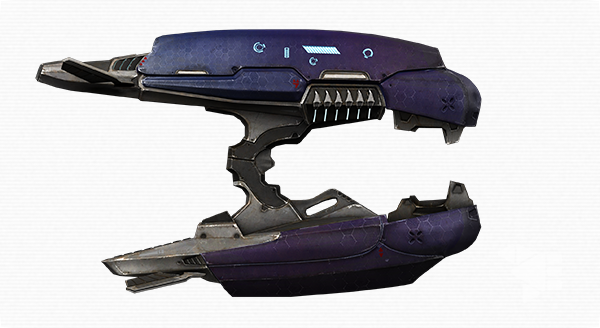
Oh, that's the Carbine?  I thought that thing was just a myth made up by those bastards that played playlists as Dinos and ran around shouting "wort wort wort" to be funny.

Here we have an example of a weapon that is perfectly capable in its own right (usually, I think in H3/H4 they intentionally made it weaker than the other options just so they'd never have to bother worrying about it.) but which rarely gets used apart from a pick-up to hold as a sidearm in case you run out of ammo in a power position you don't want to leave.

The Carbine has no role of its own, it's simply the "harder to use Covenant BR"; I say harder to use because it's single shot, versus the BR's burst.  Mistakes are punished more, and it's high shots-to-kill leave plenty of room for mistakes.

So how do we give this thing a role?  Sage Merrill had a pretty good idea once.


But if this blog is to jerk myself off--err, challenge my own design mind, I need to explore a different avenue.  One that doesn't involve "oh just aim for the body if you can't aim and you'll get a flashy kill; it'll be sweet I swear."

First let's examine the canonical design of the Type-51 Carbine.  By design, it is meant to be a riflesque version of the Type-33 Light Anti Armor Weapon...also known as the Fuel Rod Gun.  The Carbine literally fires supersonic radioactive projectiles at the target.  It's most often wielded in campaign by Jackals, the "snipers" of the Covenant military.

So using this knowledge, what can we do to the weapon to give it some identity?  Looking at its Big Sister counterpart, the Fuel Rod Gun, we know that the fuel rod "deploys" after being fired a certain range -- making it move much slower and explode upon the next target it hits.  Thinking about this, Carbines could do the same after a certain range.  Within their intended range (max red reticule range or whatever) they could still fire the standard method that ultimately operate like any other rifle in the game, but as you extend beyond that range, the fuel rod "decays" turning the bolt into an explosive projectile.  This could make it useful for pinging targets behind cover in long range skirmishes, damaging light vehicles as they attempt to flee, or packing an extra punch against smug DMR wielders who think their superior range gives them safety.

Ultimately, this change gives the Carbine a unique role as a dual-threat weapon; a rifle in standard ranges with some potential for splash damage or anti-armor potential in extreme ranges (hello BTB crowd!).  Suddenly the weapon has flavor that allows it to stand out from the other weapons of its niche, and you may actually remember it exists!  (And hey, making the Covenant Rifle explosive isn't that farfetched, we DID have a Supercombining Needle Rifle.)  And for those of you who can't visualize how I imagine the longer-ranged Carbine bolts to work...just imagine the Phoenix from Perfect Dark.

One last Halo weapon before I delve into my "bonus" topics...


"Audley, I didn't play Halo 4.  What the fuck is that?"

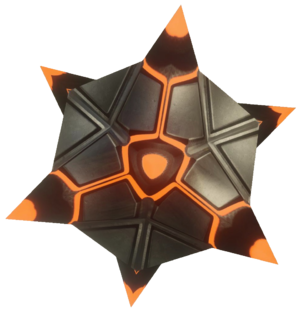
Don't worry, it's not a morning star.  It's the Pulse Grenade.

I encountered a poll on GameFAQs asking what the most useless weapon in Halo 4 was, and the #1 answer, with 40% of the vote (passing the Suppressor, Storm Rifle, and the Gravity Hammer) was the Pulse Grenade.

In my experience, this wasn't true.  Melee+Grenade throw was an instant kill with Pulse Grenades active...sharing this knowledge even convinced Eric "Gh057Ayame" Hewitt to include Pulse Grenades on-map in his Team Throwdown settings which were used for competitive tournaments during H4's lifespan.

So, if I'm so convinced Pulse Grenades were one of the strongest CQB weapons in all of Halo 4...why do I feel the need to talk about them?  It's all about player perception.

When you see the Pulse Grenade's animation, and its name, you expect it to be a sort of delayed-explosion that deals a ton of damage.  In reality, the Pulse Grenade's damage is front-loaded.  It takes place instantly in the giant circle of doom you create.  Add in Halo 3's Power Drain animation to a player's knowledge base, and you expect the Pulse Grenade's giant orange doomglobe do also deal significant damage over time.  Nope, not the case.

Literally the only good uses for the Pulse Grenade were to finish off players who were severely weakened -- the delayed effects were negligible at best and completely avoidable at worst.  But the instant burst of a well-thrown pulse grenade (or, in the primary usecase, a pulse grenade thrown at your feet immediately after a melee) was unavoidable, and made the pulse grenade a potent option as a finishing tool.

So, to reiterate clearly after all that jumbled rambling...

The Pulse Grenade needed nothing more than an animation fix to better clarify it's purpose to the users.  It was an instant burst tool, not a delayed-damage like most grenades, nor an AoE drain like the Halo series' past tool, the Power Drain, which carried a similar animation.  Clarity of design is just as important as unique flavor and potency, otherwise your users simply won't grasp how good it actually is.


That's all for my Halo weapons to rework...Now for two bonus guns.

Perfect Dark - Reaper.

OH DEAR GOD THIS THING WAS A MONSTER.  Viscerally, it was one of the most fun weapons to use in the history of FPS.  But in terms of viability...dear god, the weapon was ass.  It wasn't really intended to be a serious use weapon from what I can gather; hell, in game canon terms, humans aren't even supposed to be able to wield it, only the Skedar are.

If you didn't play Perfect Dark and are wondering what the fuck a Reaper is...  Imagine you took the bottom of a blender or food processor and made it the size of a chainsaw.  So you have a giant rotating fan-o-death that can shred people to death.  Got that in your mind?  Okay, that's just the SECONDARY fire mode of the Reaper.

Now imagine, for the primary mode...  That each of the tips of the "fan blades" can fire bullets, and as the fan spins faster, your rotating death fan of doom and despair fires faster as well, and is essentially the fastest firing machine gun in the history of anything ever.

Got it?  That's the Reaper.  Don't got it?  Here's a video.


With great fire rate comes great inaccuracy.  Dear lord the thing was inaccurate.  Unwieldy.  The melee secondary fire mode was fun, but mostly useless unless you had a really good corner to hide in for ambushes.

In terms of fun factor, the Reaper was fantastic.  It was a weapon you'd pick up just to watch it spin as you were hypnotized by murderous glee.  Unfortunately, there was just no way to reconcile its RoF with its accuracy to make it work for players...or was there?

The Reaper's kill time was surprisingly fast, when bullets actually hit.  Myself, I'm not a fan of randomly making bullets miss because you arbitrarily want to limit a gun's power.  Drastically reducing the damage per bullet and increasing the accuracy could've gone a long way to making the Reaper a bit less farfetched as a tool -- and as a cost for the increase in accuracy, tuning the recoil to actually RECOIL (rather than again, just being a random spread of bullet trajectories).  Alternately, taking the Halo "ripped-off-turret" approach of reducing the player's movement speed could also curb some of the power given back to the player by more consistency in the weapon itself.  A final route, though probably too ahead of the technology curve for Perfect Dark's day could've been to greatly increase the magazine size (from 200 to 1000) and add the potential for the gun to overheat as it approached its faster RPMs, leading a player to want to micromanage the heat and avoid spinning too fast.


And the final gun... Quite possibly the most hated gun in FPS history...


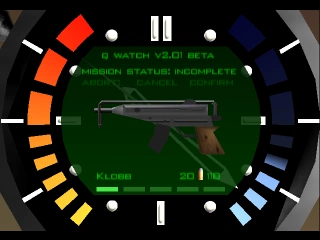
The Klobb.

How could this have been fixed?

Just delete the goddamn useless piece of shit.


That's all for my random blog on FPS sandbox design, hope you enjoyed.