Showing posts with label weapons. Show all posts

Wednesday, September 16, 2015

Audley's Workshop: Carvin' Niches for Killin' Bitches

Back to Audley's Workshop we go! In today's blog, I'm going to be talking about some various Halo weapons as well as PlanetSide 2's incarnation of the Vanu Rocket Launcher, the Lancer, and finally, my favorite FPS weapon design of all time. The general focus will be weapons with very distinct niches, whether they underperformed or overperformed in those niches.
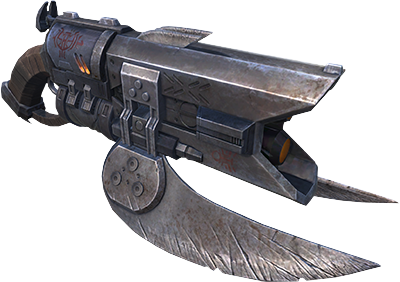


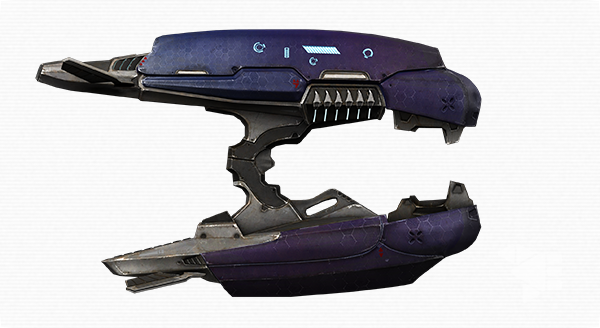
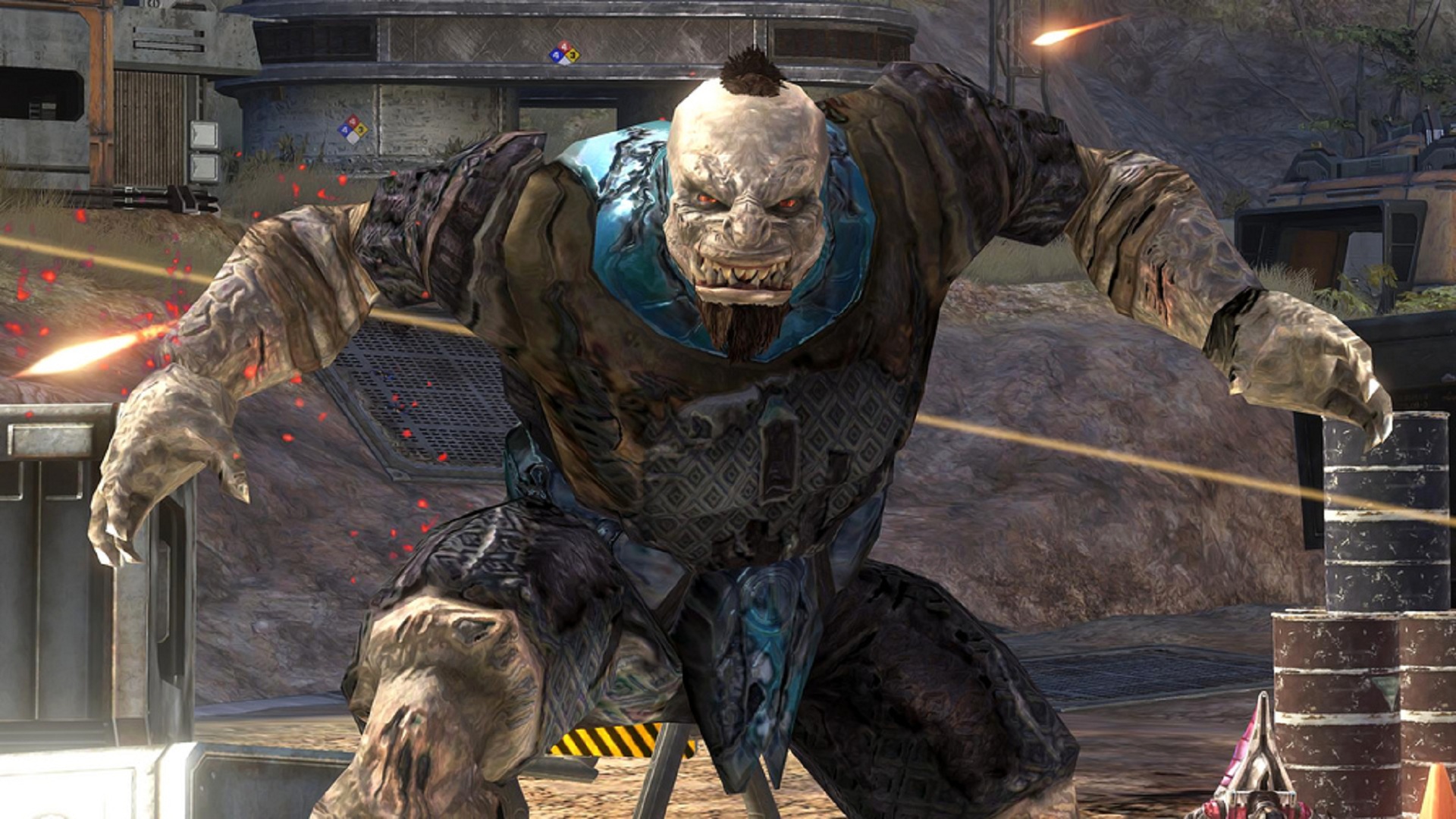
First, the gun labeled the Type-25 Carbine...but more commonly known as the Spiker. This gun looks badass. Like other Brute weapons, blades are a big part of its visual design.

I was one of the top 10 players in Spiker kills in Halo 3 according to HaloCharts back when the website was active and tracking stats through Bungie's API. So, if you're reading this and wondering, “Why does this MLG kid think he can talk about a social weapon?”...first off: I'm a BTB kid, not an MLG one. I only got into competitive 4s because there was a more established scene. I will always feel BTB is the more “pure” Halo experience and the better representation of the game's beautiful sandbox. Hell, I even took down Disco (top Social pilot) in his Banshee with Spikers once. Hitting a Banshee with short-range projectiles is not an easy task. I knew my way around the Brute equivalent to the SMG.

But wait, equivalent to an SMG? ...the Spiker is supposed to be a Carbine. Or a Spike Rifle. Why is Master Chief able to dual-wield a rifle from a species of creature more than double his size? Why is it treated like a submachine gun instead of a RIFLE OR CARBINE as the weapon name says?

Some quick notes about the Spiker:
  • Higher damage output than the SMG, and more damage to shields
  • Projectile, harder to aim
  • Spikes affected by gravity (and inertia, they move more slowly as they go)
  • Larger spread than any other weapon in UNSC/Covenant sandbox
  • Deals 2 more points of damage (TWO. REALLY?!) than default melee.

So the Spiker suffers not only from an identity problem (SMG RIFLE WHAT ARE YOU DAMN IT), but also suffers from its gameplay not matching its visual.

There are two routes we can take to make the gun feel better to the player. We can embrace the Covenant/Brute SMG identity, or we can turn the gun into a true Spike Rifle. Given the Covenant already have the Plasma Rifle to rival the SMG, but don't have an equivalent to the Assault Rifle in the context of Halo 3... let's take the Spike Rifle along the latter route. No more dual wielding.

Since the Spiker is meant to be a Brute weapon, this definitely means we need it to be fearsome up close. Brute combat was very much about rushing. Besides, the weapon has GIANT FUCKING DOUBLE BLADES attached to it. Halo 2 took the right approach to the Brute Shot's melee identity during the big patch that reworked damage, allowing a momentum Brute Shot melee to kill a target in one hit. This made the Brute Shot a fearsome close range weapon (even though the weapon itself was intended to be wielded at range.)

So step 1: Greatly increase the Spiker's melee damage. None of this 2 damage shit. Make it a one hit kill. Because you should never be in range of a Brute.


Step 2: Since we're making it live up to the Rifle moniker, rather than working as a dual-wielded SMG, we need to increase the effective range. To do this, we need to reduce the effects of gravity (projectile drop) on the spikes and reduce the enormous bullet spread of the gun. Just to make it fire a bit straighter in general, so medium range becomes a reasonable distance to try to deal some damage.

Okay, so now it's a rifle. And it's a scary rifle in melee range. But what about that old “Audley gives everything unique identity or a niche to fill” bit? Don't worry, I'm getting to that.

The Spiker fires super-heated spikes. It's not unreasonable to think they would cool off as they traveled. Plus, we've already mentioned the bullet velocity decreases as they go.

So because of this, we can take the route PlanetSide 2 takes with nearly all of its weapons – have the damage fall off at longer ranges. Up close, the Spikers spikes will deal enormous amounts of damage per bolt. Further away, the damage falls off slightly, decaying a small amount below the AR's damage output. In short, the weapon becomes stronger than the AR in closer quarters, but weaker as the range increases.

And now we've made the Spiker live up to its name as the Type-25 Carbine / Spike Rifle. And made it live up to its visual of the blades.

(Of course, if you wanted to turn it into a Tier 2 Power Weapon rather than just “the Brute AR”...you could go a step further and have the super heated visual of the glowing weapon also transfer to the weapons to where its damage increases at higher RoF / the damage carries longer range before the falloff occurs, but this would probably be a bit much / borderline superfluous.)

Since we're on the subject of Pseudo Assault Rifles...next on the anvil...


The Halo 4 Suppressor.

Even down to the bolts, this gun was basically a re-skinned Spiker. But we've already adjusted the Spiker. Let's not give the Suppressor the same treatment. In the context of Halo 4, we have the Assault Rifle... humanity's relatively low shield damage, high health damage automatic weapon...and the Storm Rifle, the Covenant projectile high shield, low health damage automatic weapon. It's fairly boring and doesn't create any interesting decisions or improved niche to make the Suppressor a “neutral” version of this where the damage is in the middle. I believe (might be mistaken) the Suppressor had the highest RoF and the highest bullet spread of Halo 4 Automatic weapons.

So...let's change that. Let's give the Suppressor its own unique niche among Automatics that no other Halo automatic has attempted. After all, the thing is called the Suppressor. Let's go all out on its capabilities for suppressing fire (extinguisher).


Call it plagiarism, but there's actually a weapon from another game I think would fit perfectly for the Suppressor's intended niche.
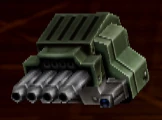


If you know this weapon, congratulations, you've played one of the most fun arena game series of all time, Armored Core. This is the “Finger” – it had various different prefixes over the franchise's different games.

But this gun was AMAZING at close ranges.

Why?

Because it was a MACHINE GUN SHOTGUN. It had an absurd rate of fire but also fired multiple bullets at once.

Now put that in Halo.

Turn the Suppressor into a gun that fires a METRIC FUCKTON of bullets, all at the same time. A barrage of bullets, blazing across the sky. It becomes a complete melter at close quarters. Give it a large enough magazine and it can become a weapon that, although inefficient for killing at range, could at least sustain enough swarm of bullets to scare off those who fear bees.

(Shotgunified Automatic weapons in Tower of Guns are also pretty fucking badass. Or automatic version of the Shrapnel Trumpet. You know, whatever.)

Speaking of shotguns in Halo 4...


The Boltshot!

Because who doesn't want to SPAWN WITH A SHOTGUN, right?

Someone at 343, in the creation of the Halo 4 sandbox, thought to themselves, “Creating a gun that can deal instant kill damage, and being able to use that gun off spawn is definitely a healthy thing for this game.”

Granted, functionally its instant kill was similar to the Plasma Pistol – gated by a charge-up that was required before the gun fired. In theory it wasn't too oppressive. Unfortunately, when you arm potentially everyone in a game with a weapon that can instant kill, the problem is that everyone in the game will take the weapon that can instant kill. When that weapon is range gated, it leads to gameplay issues.

The Boltshot was a unique pistol. And a cool design. But it was unquestionably too powerful.

So, what can you do to the Boltshot to keep its identity of “Shotgun Pistol” without turning it into the Halo 3 Mauler but also keeping it from being a one-hit kill weapon?

  • Nerf the damage. Make its charged up damage deal full shield damage, but make the body damage fairly weak, such as taking 3 charged shots to kill a foe. With this change, you can make it so the effective range of the charged shot isn't forced to be immediate vicinity.
    • This will encourage using the pistol form's headshots to finish off a foe, turning the gun into a self-sustained noob combo.
  • Increase the charge-up time slightly. Since it's not killing foes with the Charge now, it doesn't need a slow charge.
  • Decrease the amount of ammo consumed by a charge-up to 3. This will further encourage charge shots + follow-up pistol bullets.

With these changes, you turn the gun from an outright shotgun pistol into a gun that's balanced for skill. It's got the pseudo-shotgun identity of having a ton of burst damage at close range, but you still need to be able to land the pistol headshots in order to reliably finish a kill. Unlike a true Noob Combo though (the Plasma Pistol + Battle Rifle combo from Halo 2, if you're for some reason unfamiliar), this one-weapon version is limited in range. So there's still room for swapping out your weapon for a better version.

I've done a good job with my segues so far this blog... but now I'm all out of good segues. A good one for this next weapon is a bit out of Reach.


The Plasma Launcher. Also known in the BTB community as Blueberries. This gun was actually pretty useless in the vehicle killing niche. Where it should have theoretically been strong.

It could take down a Warthog, but what couldn't? The Warthog's armor was paper thin and shredded easily by a team's worth of DMRs. Which, coincidentally, had a stronger scope than the Plasma Launcher.

The true terror vehicles of BTB were tanks, the pseudo-tank Revenant, and the Banshee. Tanks could nearly shrug off the damage. The Revenant was agile enough to escape the extremely slow engagement time. And the Banshee only needed to do a single roll to break any lock-on that was attained.

So basically, you have a useless power weapon on your hands. Because again, the DMR out-ranges the Plasma Launcher, so even against foot soldiers, the weapon with the potential to one-hit kill is outclassed.

The draw of the Plasma Launcher was supposed to be it's ability to fire multiple sticky grenades at once, in addition to its lock-on functionality.

I will give credit where credit is due, the slow projectile speed means there's plenty of room for counterplay to the power weapon. Unfortunately, combining a necessity to lock on to truly be effective with a slow projectile speed means you're really hurting for effectiveness. So what can we do to make the Plasma Launcher more useful without making it overpowered?

For dealing with infantry, giving it the ability to lock onto multiple targets with a single charge could help a lot, turning the weapon into a “crowd control” weapon, rather than a “Okay I pick you.” “Now you.” one by one weapon. Allowing each of the four grenades to seek out a different target with up to four potential locks puts more power in the hands of the wielder in situations where he is outnumbered, with opportunity to take everyone down with him, if he's fast enough on the draw.

With the amount of armor abilities in Reach that catered to mobility or defense (read: basically all of them), there were plenty of ways to escape a Plasma Launcher bolt if it was coming your way. Because of this, speeding up either the grenades' travel time or the target acquisition speed is important for empowering the weapon. Players who complain about power weapons being powerful when given so many tools for counterplay BEYOND JUST DODGING, WHICH IS ALSO POSSIBLE will learn the power of the blueberries.

But how do we make it better against the Banshee?

If you improve the travel time, keeping the lock-on time the same, you can edit the Banshee to only be able to shed ATTEMPTED locks, rather than already-secured ones. The Banshee when piloted by ace pilots probably won't spend enough time without flipping to get a lock on in the first place, so this would generally solve that problem.

As for making the weapon more effective against tanks, that's simply a matter of the player wielding it getting in a position where they won't be killed attempting to get a lock on.

That's all for Halo on this blog, but it's time to talk about another “rocket launcher” that featured a charge-up time. The PlanetSide 2 Vanu Sovereignty Lancer.


In the original PlanetSide, the Vanu Lancer was essentially a 6-shot rifle that dealt significant damage to vehicles/armor. PlanetSide 2 mostly tried to keep that in tact, but turned the Lancer into a bitchified version of the Halo Spartan Laser, with three levels of charge up damage.

As with many of the weapons in PlanetSide 2's arsenal, the weapon had to be balanced for “What happens if a fuckton of people use it?”

As a result, the weapon felt almost useless for a single person to use. It didn't fill a niche of a “rocket launcher” at all for an individual. If you were by yourself, it was almost always more efficient to carry a dumbfire or a lock-on rocket launcher as a Vanu soldier, because it meant you could either kill infantry that approached or scare off vehicles with the threat of a lock on.

So how do you balance an anti-vehicle weapon for scale? How do you make a weapon that is potentially oppressive for squads of people to use feel satisfying for an individual to use? This is an important design question for every piece of the PlanetSide sandbox, as well as being important to ask in games like Battlefield or Halo in the case of BTB and upcoming Warzone. (Hell, in League of Legends we saw three instances where a summoner spell taken by an entire team ended up problematic because of how stacking them worked. Heal, Promote, and Fortify all had design problems regarding scalability.)

So now, what do you do to make a weapon such as an anti-vehicle laser interesting/useful for an
individual, but not overpowered for a squad?

The Lancer's identity was supposed to be a sort of “Anti-Vehicle Sniper” – it even required some degree of leading your shot despite being a laser beam.

Unfortunately an easy answer like “give vehicles weak points to aim for” was not an explorable option for PlanetSide 2 since that would mean additional sprites were necessary which would have destroyed game performance.

I do believe the Lancer was the longest range “Rocket Launcher” in the game. So wielding it, even as an individual, meant one could at least harass vehicles from far out of their engagement range. However, because of Engineers' potential to repair a vehicle more quickly than a Lancer could damage it, it wasn't really possible to do relevant chip damage to a vehicle.

Instead of buffing impact damage, giving the Lancer a damage-over-time effect which does not stack (but similar in power to the amount a single Engineer could repair, with a duration roughly equal to a charge time for another Lancer shot) would allow a single Lancer to feel impactful against a target – ensuring that each shot would be impactful, while the damager-over-time would offset the potential for the vehicle's driver to simply hop out and repair until the Lancer-wielder ran out of ammo. Additionally, since the damage-over-time effect does not stack (simply reapplies), having multiple Lancers firing would not make the weapons any more fearsome than usual in a group.

It would empower an individual, but keep the groups in check.

And so the PlanetSide 2 Lancer is more satisfying for an individual and still relevant in its niche as the Anti-Vehicle Sniper.

So finally, we come to my favorite weapon from any shooter ever.

It comes from Unreal Tournament (big surprise)


This is the Shock Rifle. A glorious projectile weapon with a hit-scan alternate fire method.

I'm not here to redesign the weapon or suggest any methods on how to improve it. I'm just here to share the gospel of a fantastic weapon.

The gun could fire either straight laser beams or “shock cores” which traveled significantly slower than the laser beams. The shock cores could then be hit by the laser beams and detonated from a range, dealing a massive amount of AoE damage that usually killed a target it one hit.

It's a brilliant skillful design with tons of nuance and mastery. Good counterplay due to the slower projectile speed of the instant kill. Tons of clarity of what's going on. Every gun should strive to be as awesome and satisfying as the Unreal Tournament Shock Rifle.

And if the Shock Rifle weren't cool enough, they took that gun concept and put it into a vehicle as well, known as the Hellraiser, which could rapid fire Shock Cores, and then detonate them in a chain of explosions. Just in case you needed to feel truly epic.


With that, this blog is donezo. Hope you enjoyed the read!

Monday, May 25, 2015

Audley's Workshop: Balancing an FPS Sandbox


A while back, I did a blog on having certain weapons appeal to multiple playstyles, referring to the horribly vague MtG archetypes Timmy/Johnny/Spike to label the players to whom those weapons would appeal.  It focused on having weapons in Halo be both fun and competitively viable.  I mentioned the Halo Reach Grenade Launcher as the pinnacle of success for designing weapons for all players, then pointed out three examples of weapons that appealed to two archetypes and failed to meet the standards for the third.

Today, I'm revisiting Audley's Workshop with a focus on tweaking some weapons from the Halo series to make them more viable competitively or more appealing to the broader player base.  There won't be any focus on Timmy/Johnny/Spike here, just strictly on some weapons that get overlooked in Halo for either being shoved too far into a niche, being too unreliable, or simply not having enough identity on their own to be embraced by the players.


The Needler.  Everyone knows the pink mist.  Or, in a strafe battle, the pink missed.

Halo 3 and Halo 4 had decent incarnations of the weapon, but even then its niche was very difficult to abuse and relied heavily on flanking and catching players by surprise in order to get kills with.  By the time a player had time to turn and react to the first needle connecting in H3, the others were already locked on and tracking to set up the super combine.

But as we move into Halo 5, where the Thruster is readily available, and players are going to be able to quickly break those lock-ons, how does one make the Needler more useful?  Hell, the weapon already had trouble keeping up with any side-to-side motion, whether strafing or simply running in a straight line perpendicular to the wielder... so where is the Needler missing power?

While you may think, "Hey, the Needler's tracking could just be improved to make it harder to dodge!" -- reducing counterplay isn't a wise decision for a weapon that is theoretically a very fast kill weapon between time-of-engagement to time-of-death.  While the actual travel time of the needles makes the kill time long, the actual time to react from being shot is substantially smaller.  Reducing post-reaction counterplay is not the way to go.

"Well then Audley, I guess you have an idea?"  I do, and I've mentioned it on forums in the past.  You know what weapon the Covenant never had a true successor to in Halo, despite having plenty of CQB weapons?  The shotgun.  What if, instead of a standard melee, using the melee with the Needler unleashed all of your needles in a uniform cone ahead of you?  If seven, or eight, or whatever the arbitrarily chosen supercombine number happens to be managed to lodge themselves in the target, you get the insta-kill as usual.  Suddenly the Needler is a much better weapon in CQB, which immediately improves its definition in the sandbox.

This also improves the Needler's options versus a player running perpendicular to you; instead of simply praying the tracking decides to work at your range, you lead your shot and unleash.  If they aren't terribly far away, and you angle your shot (melee) correctly, enough needles will land in their side to score a medium range kill with the Needler.  (Audio cues will be necessary for this "MULTIPLE NEEDLES INBOUND" situation though.)

Voila, the Needler is now the best weapon in Halo history.  You're welcome, Bung343.


Oh, nice, the Plasma Rifle.  A weapon that gets praised in Halo: CE for fitting well into the sandbox with its hitstun and quick camo uses.  Hardy LeBel did a wonderful job with this gun and making it useful in Hal-oh, wait, you're telling me outside of HCE no one uses the Plasma Rifle?  Because it's a shit generic automatic weapon with no niche or role at all?

Well, we need to fix that!  No weapon should be useless.  Let's talk about how to make it better, without treading down roads been walked before, such as the hitstun method which limits counterplay potential.

As a visible projectile-based automatic weapon, the Plasma Rifle is a weird beast.  Players can literally dodge the shots (unlike the hitscan incarnations of the Assault Rifle) and see where they need to move in order to stay ahead of their opponent's reticule.  This is good, it offers counterplay.  The slower projectile speed compared to most weapons in the game makes it difficult to use.  It leaves us with an unreliable weapon, especially at longer ranges.

In non-Combat Evolved Halo games where the Plasma Rifle is available to be used, its most common role is for a quick couple of shots followed by a melee.  A pretty shitty niche as other CQB/melee weapons outshine it in that role, and other automatics (SMG/AR) outshine it in gun roles.  As a gun, the Plasma Rifle is pretty shit.  Its other common use, in H2A's case, is to put a couple of shots in, back down into cover while you switch to your BR, and finish with a headshot.  A role where it is outshined by a Plasma Pistol (outside of Warlord, where there is no PP).  Uh oh, looks like we have a weapon that isn't very useful in its intended niche.

So how do we make the Plasma Rifle more reliable at range, or stronger as an automatic?  How about we do both at once -- by removing the limitation that each shot fired only has one particle, instead splitting it into two?  To make the weapon more effective at range, the plasma could feature a dissipation effect -- where the plasma spreads out, becoming able to hit a wider area at range.  This would still have significant damage versus shields, but be relatively useless versus player health.  The damage would still degrade at range based off how much of the spreading disc of plasma hit the player, but the focus here is to soften shields.  The second part of the damage would remain in the center of the disc, increasing focus on hitting your shots accurately as a player gets low on health (in line with Halo's core combat philosophy across the series where you body shot until a player is low/out of shields), then headshot.  The central portion of the Plasma Rifle's bolt could convey headshot bonuses, as well as pack a substantial punch to health any time it connects to an unshielded player.

Suddenly you've got a weapon with nuance for use (do I focus on aiming accurately or just try to drop shields as best as I can, do I have teammate help?) while it still has potential to stand on its own as an automatic, due to having a centralized point of increased damage for penetrating health and finishing off players that have had their shields dropped by the high energy plasma.

But let's not stop there; I've only been talking in 4v4 so far, there's another niche the Plasma Rifle was absolutely overshadowed by its UNSC counterparts...in BTB, versus vehicle health.

It makes zero sense to me that UNSC vehicles are so resistant to plasma damage.  That shit should shred the fuck out of vehicle health.  C'mon now.  Bump up the UNSC vehicle health damage from Plasma-based weaponry.  UNSC vehicles are built to withstand other UNSC vehicles' weaponry, not Covenant weaponry.  UNSC ARs/Magnums/Rifles should not be stronger against vehicles (outside of rifles versus weak points) than Plasma Rifles.

Okay, now we've buffed the Plasma Rifle to viability.  Who are we looking at now?


I'm afraid I don't recognize that weapon.  I don't think I've ever seen anyone use it.  What is it?

Oh, that's the Carbine?  I thought that thing was just a myth made up by those bastards that played playlists as Dinos and ran around shouting "wort wort wort" to be funny.

Here we have an example of a weapon that is perfectly capable in its own right (usually, I think in H3/H4 they intentionally made it weaker than the other options just so they'd never have to bother worrying about it.) but which rarely gets used apart from a pick-up to hold as a sidearm in case you run out of ammo in a power position you don't want to leave.

The Carbine has no role of its own, it's simply the "harder to use Covenant BR"; I say harder to use because it's single shot, versus the BR's burst.  Mistakes are punished more, and it's high shots-to-kill leave plenty of room for mistakes.

So how do we give this thing a role?  Sage Merrill had a pretty good idea once.


But if this blog is to jerk myself off--err, challenge my own design mind, I need to explore a different avenue.  One that doesn't involve "oh just aim for the body if you can't aim and you'll get a flashy kill; it'll be sweet I swear."

First let's examine the canonical design of the Type-51 Carbine.  By design, it is meant to be a riflesque version of the Type-33 Light Anti Armor Weapon...also known as the Fuel Rod Gun.  The Carbine literally fires supersonic radioactive projectiles at the target.  It's most often wielded in campaign by Jackals, the "snipers" of the Covenant military.

So using this knowledge, what can we do to the weapon to give it some identity?  Looking at its Big Sister counterpart, the Fuel Rod Gun, we know that the fuel rod "deploys" after being fired a certain range -- making it move much slower and explode upon the next target it hits.  Thinking about this, Carbines could do the same after a certain range.  Within their intended range (max red reticule range or whatever) they could still fire the standard method that ultimately operate like any other rifle in the game, but as you extend beyond that range, the fuel rod "decays" turning the bolt into an explosive projectile.  This could make it useful for pinging targets behind cover in long range skirmishes, damaging light vehicles as they attempt to flee, or packing an extra punch against smug DMR wielders who think their superior range gives them safety.

Ultimately, this change gives the Carbine a unique role as a dual-threat weapon; a rifle in standard ranges with some potential for splash damage or anti-armor potential in extreme ranges (hello BTB crowd!).  Suddenly the weapon has flavor that allows it to stand out from the other weapons of its niche, and you may actually remember it exists!  (And hey, making the Covenant Rifle explosive isn't that farfetched, we DID have a Supercombining Needle Rifle.)  And for those of you who can't visualize how I imagine the longer-ranged Carbine bolts to work...just imagine the Phoenix from Perfect Dark.

One last Halo weapon before I delve into my "bonus" topics...


"Audley, I didn't play Halo 4.  What the fuck is that?"

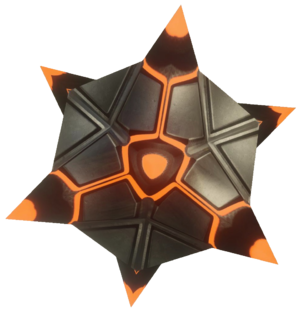
Don't worry, it's not a morning star.  It's the Pulse Grenade.

I encountered a poll on GameFAQs asking what the most useless weapon in Halo 4 was, and the #1 answer, with 40% of the vote (passing the Suppressor, Storm Rifle, and the Gravity Hammer) was the Pulse Grenade.

In my experience, this wasn't true.  Melee+Grenade throw was an instant kill with Pulse Grenades active...sharing this knowledge even convinced Eric "Gh057Ayame" Hewitt to include Pulse Grenades on-map in his Team Throwdown settings which were used for competitive tournaments during H4's lifespan.

So, if I'm so convinced Pulse Grenades were one of the strongest CQB weapons in all of Halo 4...why do I feel the need to talk about them?  It's all about player perception.

When you see the Pulse Grenade's animation, and its name, you expect it to be a sort of delayed-explosion that deals a ton of damage.  In reality, the Pulse Grenade's damage is front-loaded.  It takes place instantly in the giant circle of doom you create.  Add in Halo 3's Power Drain animation to a player's knowledge base, and you expect the Pulse Grenade's giant orange doomglobe do also deal significant damage over time.  Nope, not the case.

Literally the only good uses for the Pulse Grenade were to finish off players who were severely weakened -- the delayed effects were negligible at best and completely avoidable at worst.  But the instant burst of a well-thrown pulse grenade (or, in the primary usecase, a pulse grenade thrown at your feet immediately after a melee) was unavoidable, and made the pulse grenade a potent option as a finishing tool.

So, to reiterate clearly after all that jumbled rambling...

The Pulse Grenade needed nothing more than an animation fix to better clarify it's purpose to the users.  It was an instant burst tool, not a delayed-damage like most grenades, nor an AoE drain like the Halo series' past tool, the Power Drain, which carried a similar animation.  Clarity of design is just as important as unique flavor and potency, otherwise your users simply won't grasp how good it actually is.


That's all for my Halo weapons to rework...Now for two bonus guns.

Perfect Dark - Reaper.

OH DEAR GOD THIS THING WAS A MONSTER.  Viscerally, it was one of the most fun weapons to use in the history of FPS.  But in terms of viability...dear god, the weapon was ass.  It wasn't really intended to be a serious use weapon from what I can gather; hell, in game canon terms, humans aren't even supposed to be able to wield it, only the Skedar are.

If you didn't play Perfect Dark and are wondering what the fuck a Reaper is...  Imagine you took the bottom of a blender or food processor and made it the size of a chainsaw.  So you have a giant rotating fan-o-death that can shred people to death.  Got that in your mind?  Okay, that's just the SECONDARY fire mode of the Reaper.

Now imagine, for the primary mode...  That each of the tips of the "fan blades" can fire bullets, and as the fan spins faster, your rotating death fan of doom and despair fires faster as well, and is essentially the fastest firing machine gun in the history of anything ever.

Got it?  That's the Reaper.  Don't got it?  Here's a video.


With great fire rate comes great inaccuracy.  Dear lord the thing was inaccurate.  Unwieldy.  The melee secondary fire mode was fun, but mostly useless unless you had a really good corner to hide in for ambushes.

In terms of fun factor, the Reaper was fantastic.  It was a weapon you'd pick up just to watch it spin as you were hypnotized by murderous glee.  Unfortunately, there was just no way to reconcile its RoF with its accuracy to make it work for players...or was there?

The Reaper's kill time was surprisingly fast, when bullets actually hit.  Myself, I'm not a fan of randomly making bullets miss because you arbitrarily want to limit a gun's power.  Drastically reducing the damage per bullet and increasing the accuracy could've gone a long way to making the Reaper a bit less farfetched as a tool -- and as a cost for the increase in accuracy, tuning the recoil to actually RECOIL (rather than again, just being a random spread of bullet trajectories).  Alternately, taking the Halo "ripped-off-turret" approach of reducing the player's movement speed could also curb some of the power given back to the player by more consistency in the weapon itself.  A final route, though probably too ahead of the technology curve for Perfect Dark's day could've been to greatly increase the magazine size (from 200 to 1000) and add the potential for the gun to overheat as it approached its faster RPMs, leading a player to want to micromanage the heat and avoid spinning too fast.


And the final gun... Quite possibly the most hated gun in FPS history...


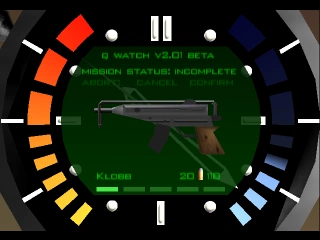
The Klobb.

How could this have been fixed?

Just delete the goddamn useless piece of shit.


That's all for my random blog on FPS sandbox design, hope you enjoyed.

Tuesday, December 16, 2014

Designing Tensai, Part 4: Weapons of Mass Prediction


In the early stages of Tensai's design (well, early is relative, I spent less than a week on the actual core systems design on Tensai before going straight into content design of moves, creatures, and the items), I made the decision to give each creature two equippable items: a Weapon and a Trinket.

Trinkets were essentially Pokémon held items. There were analogous ports such as my own version of Leftovers, Life Orb, and the Choice items from Pokémon, but of course... because of the good ol' trusty ACTION TYPE SYSTEM I've been beating an entire graveyard of dead horses about... there were some unique additions to the system.

The Primordial Switch and Reversal Charm trinket would be announced when a critter holding them swapped into battle, because their effects were QUITE important. The Primordial Switch trinket reversed the elemental hierarchy (so Fire would no longer be strong against metal, ice, and wood, but instead be strong against rock, water, and air.) The Reversal Charm would do the same for Action Types, reversing the flow into the opposite direction.

Pokémon's Arceus “Plates” made their own analog home in Tensai's treatment in the form of Amulet trinkets, which boosted the power of elemental damages by 20%. Of course, since elements aren't the only damage types it meant I also got to make Trinkets for...ACTION TYPES! These trinkets carried a bonus effect in addition to boosting damage of that Action Type: the creature holding that item would enter the battlefield in the Stance of their Trinket. (This Stance ONLY applied on entering the battlefield, not when idling on a turn, so if a Creature had a passive stance already, the Trinket wouldn't overpower the Creature's innate ability.

I tried not to go too heavy-handed with Trinkets, and stick close to the proven designs from Pokémon; with plans to balance or make additional creations/subtractions after playtesting to see what worked and what didn't. With trinkets out of the way, it's time to talk about the other items: Weapons.

I created the Weapon slot as a second answer in addition to Action Types to help alleviate problems of being in an elementally disadvantageous situation. Basically, Weapons were a generic move that is available to all creatures, regardless of their element. There were Rods, Halberds, Shields, Clubs, and Slingshots (to represent Magical, Aerial, Defensive, Melee, and Ranged action types) of each of the seven elements as generic 25 Essence-cost moves.

The general expectation behind the standard weapon choices was that players would look to equip a weapon that fully covered their type weaknesses (A Fire creature would want a Wood weapon to have strength against Air/Water/Rock creatures that counter it.) Of course, with Pokémon moves like Toxic, Substitute, and Rest being prevalent in TMs and able to be learned by nearly all Pokémon, there were weapons like the Kitchen Knife, Decoy, and Panacea respectively to translate those moves into a Weapon option for critters of Tensai, at the opportunity cost of type coverage.

But the buck doesn't stop there for items. I'd added one additional battle command option for players that didn't exist in Pokémon: The ability to swap items between your Critters. For example if you had an active creature that was getting low health (but likely able to survive an idle turn), you could swap your damaging weapon with a Panacea to fully heal and fall asleep for a few turns. If you had a creature with the Flying passive (Aerial Stance) that also relied on Aerial moves for its best damage, and had reason to fear your opponent's ranged moves, you could use your turn to swap your Trinket for a Reversal Charm held by another member of your team, adjusting your strategy on the fly.

If you wanted to bring in a creature with a Choice item in Pokémon, after using the move you are locked into using that same move until you swap out the Pokémon, sometimes losing a type advantage you'd backed the opponent into just because you couldn't undo your move selection. With the ability to swap items in Tensai, bringing out a creature with a Curse of Speed (Choice Scarf) could enable you to use your superior speed to knock out an enemy, then instead of swapping out your creatures, simply swap your Trinket to another member of your team, freeing up the ability to use any of your moves. While it would cost you a turn, you would not forcibly lose any positional advantage you had earned through the use of the Choice item.

The ability to change weapons also gave one other option: to sacrifice the elemental advantage your weapon was intended for to ensure you had Action Type coverage over your opponent's creatures after scouting his moves. Say, for instance, your opponent favored a Magical move for damage, and you did not have a Melee move in your creature's 3 move set, and currently had the Flowing Halberd (Water Aerial) weapon equipped. You could trade the Halberd to a creature with the Stone Club (Rock Melee) in order to get access to a move to negate the incoming damage of their largest threat, either forcing them to use a less efficient move by threat of you having a counter or forcing them into a game of chicken.

This ability to trade items between creatures could allow a player to cover situations their team was not truly prepared for by giving creatures action types that weren't prepared in team creation, and created dynamic customization as the battle unfolded.

I was a bit worried that even with the weapon slot, players might feel only 3 moves per creature was a little underwhelming, so I also made sure to design each creature with its own Signature Move. The giant flaming bear zodiac (I'll go into this when I talk about the world design of Tensai) creature Guiredaro had the ability to use Bear Hug, grappling its opponent and transferring any other negative status effects from the user to the target. Guiredaro was designed around setting himself Aflame (a damage-per-turn status effect) and then transferring that status to the opponent. The other fire zodiac creature, the Firefly, was designed around setting itself Aflame to heal itself, as fire-elemental moves healed it. Its signature move, Burn Up cured negative status effects and THEN set it Aflame.

One of the metal zodiac creatures was a squirrel themed around magnets; its signature move was called MagLev, which inflicted the status effect “Juggled” for one turn – a status effect that tied back into my Action Type system by ensuring if an Aerial move hit the target next turn, it took double damage (similar to a critical hit, only specific to one Action Type). If your creature was Juggled, you had to be extremely wary of an incoming Aerial attack. So you could prepare a Ranged attack...but again, the layers upon layers prediction come forth.

By making Signature moves for each of the creatures, it also adds a specific expectation of what the Action type that creature will use for its primary damage source once a player becomes familiar with the game. If you see a Guiredaro Aflame, you know he wants to Bear Hug you, a melee move. This preconceived expectation of a player's moves helps dictate the flow of an average battle, but as players become more intimately familiar with both the game and one another, it adds inherent depth into the possible interactions.

Combined back with the ability to swap out items, the semi-scripted nature of battle created by Signature Moves helps allow a player know what's coming before it comes and prepare for it by getting their items where they needed to be before they needed to be there. Or after. Whatever.

Regardless, the Action Type horse army has been sufficiently beaten to death, so my next blog on Tensai is going to focus on something else. Not sure yet what it will be. Could be the Astral Gate world in which Tensai is set (a fantasy world I've been worldbuilding for nearly 6 years now.) Might be just the Zodiac alone. We'll see when I get inspiration to write again. Thanks for reading!


Part 2
Part 3