Showing posts with label halo 4. Show all posts

Tuesday, September 8, 2015

Audley's Workshop: Another Visit to the Halo Sandbox

Time for another visit to Audley's Workshop! Back on the subject of the Halo sandbox this time rather than maps. And this time, I'm going to be talking about something very near and dear to my and the majority of Halo players' everywhere's hearts. A piece of the Halo sandbox that was welcomed with open arms and loved by everyone who ever used it.

And in case you haven't caught onto the sarcasm just yet...

I'm talking about Armor Abilities (and some Halo 3 equipment).

Now, you probably already want to stop reading because I mentioned those two awful words that made many a Halo player stop playing. But I encourage you to stay, even after I make this shocking next statement: I liked the idea of armor abilities. I just despised the implementation, both from the perspective of a player and from the perspective of a designer.

Today, I'm specifically going to be speaking about the abilities that were designed to increase your survivability. And although I stress mobility is survivability, I'm not going to be speaking on mobility today – we'll save that for another time. For this subject, we're talking:

  • Reach Armor Lock
  • H4 Hardlight Shield
  • H3 Bubble Shield
  • H3 Regenerator
  • Reach Drop Shield

Before I delve into any individual bit, I want to point out why these are generally all bad for Halo's gameplay. The general consensus among players that complained about them revolved around two arguments. The first, “It lets an idiot get away with making dumb plays and survive.” The second, “It slows down gameplay.”

To anyone arguing the former: No, shut up, you're wrong. It increases the amount of play options available to a player by giving them more opportunities to survive an encounter or wait for help. Them taking a survivability ability alone does not guarantee the “dumb play” will work. It enables them to make larger perceived risks with the knowledge they have more safety than is immediately apparent. This is actually a positive in my eyes.

But then you take the latter. Slowing down gameplay. Making it more time consuming to punish players for overextension is frustrating in the best case scenario. In the worst case, it gives the aggressive idiot time to be saved by his teammate. (Audley, weren't you just saying they can take more perceived risks? Wouldn't this be one of those?)

Let's talk Armor Lock.


Armor Lock was by far my favorite (and probably my most used) Armor Ability in Halo Reach. I adored its two primary functions: Parrying explosives and EMPing vehicles.

Unfortunately, Armor Lock was overtuned. Although it was meant as a method to survive fatal damage and to disable vehicles, it ended up being far stronger. Vehicles had to be terrified of attempting to splatter players running across an open field, as Armor Lock wouldn't just EMP their vehicle. It would outright destroy it. The attempted splatter would deal more damage to the vehicle than running full speed into a brick wall or colliding with another vehicle.

Rather than being used to survive fatal damage, players would hold Armor Lock for its insanely long duration and wait for teammates to come clean up. In some cases, such as Slayer variants on Countdown in default settings, full teams of Armor Lock played their own version of leap frog alternating armor locks to take down opponents. It was a grave oversight that led to extremely poor emergent gameplay.

The nerfs given to the ability when 343 took over were too conservative. Armor Lock had two distinct niches in which it could exist, as outlined above.

Gutting the duration of Armor Lock to only let it last a fraction of a second (you know, to make it specifically avoid bursts of damage) would've gone a long way toward making the ability require skill to use rather than “Let me go make a dumb play and bait people while I'm invincible.”

Further, removing the self-inflicted vehicular suicide functionality (and replacing it with further stressing of the Armor Lock's original intent of EMPing the vehicle) would also have made the ability less daunting in the context of Big Team Battle or open maps.

Even with these two extreme nerfs (duration and reflected damage), Armor Lock still is the dominant choice in its niche (surviving fatal explosions and avoiding being splattered by vehicles) – but “edge case” (read: THE WAY IT ACTUALLY GOT USED ALL THE FUCKING TIME) uses of overextending and sitting in your impenetrable glowy fortress of autofellatio for 5 seconds while praying your teammates saved you would be completely eradicated.

It also wouldn't effect the little known aspect of the Armor Lock EMP that I abused – where the shields of a player would be drained when used at melee range, allowing you to instantly kill a player with a melee if they stood over your armor locking body. This added a nuance to CQB encounters, and if the Armor Lock duration were more along the lines of a quarter of a second rather than several seconds, it could lead to players attempting to block an enemy melee and immediately countering with EMP+Melee of their own if CQB devolved into a fist fight.

Armor Lock is fixed. But let's stay on the same track for our next subject.


The good ol' Hardlight Shield.

This was another instance of an armor ability that had really cool moments, but ultimately degraded into a “Oh, fuck, I'm going to die so let me just hold onto this button as long as I possibly can and pray for deus ex machina or for them to run out of ammo!” ability.

Hardlight Shield was really cool when you deflected a rocket right back at the rocketeer and killed him with it. It was a rare occurrence since the deflection angles were really awkward and hard to figure out (too much curve to the shield, made it really hard to actually aim.)

Like Armor Lock, HLS was a really cool parry option introduced to Halo. And also like Armor Lock, rather than embracing the Parry identity, it was given a lengthy duration which turned its identity into a hulking Riot Shield-esque ability which slowed your movements while blocking any incoming damage from that direction.

343 definitely learned lessons from Armor Lock in Hardlight Shield's design: shields didn't recharge during use, and the immunity to damage was only directional. They seem to have also decided Armor Lock's immunity to being splattered was too strong and allowed HLS users to become pavement paint.

Hardlight Shield was essentially a nerfed Armor Lock – you are still exposed to damage from most directions (and even some areas on the front, like your feet) and still susceptible to grenades, so long as they're thrown a little extra distance. Because of these additional vulnerabilities, I managed to convince Gh057Ayame to include Hardlight Shield for testing as one of the potential Armor Abilities to call down with Personal Ordnance in Team Throwdown settings.

However, despite being a “nerfed version of Armor Lock” its dragging duration allowed players to use it while trying to hobble back into cover during a losing fight, or to simply wait for a teammate to be able to help. I recall seeing Pistola use the ability in one AGL tournament to great effect, as the Wizard of staying alive would certainly do. He abused its power well and made sure to annoy enemy players by appearing to be overextended, but knowing he could get back to cover if he truly wanted to.

I think one of the biggest mistakes in the Hardlight Shield's design was the continued focus on reduced mobility in exchange for its damage mitigation. So Audley, what would you have changed about Hardlight Shield if you had been its designer?
  • Reduce the duration. Maybe not a quarter second like Armor Lock (since this is much more vulnerable) – something closer to 1-1.5s. A full 1v1 kill time worth of timing, but no more.
  • Leave the player's mobility completely in tact. That's right, even allow them to sprint with the Hardlight Shield up. This encourages a player in a hallway battle to activate their shield and rush at the unsuspecting foe. It encourages making aggressive plays with the ability.
  • Normalize the deflection of the shield / Flatten the shield. Make it so things hitting you head on are deflected directly back (in most cases, it seemed things went off to the right.). The ability to deflect rockets back at the rocketeer (or Scorpion tank shells) was one of the most interesting interactions of the ability. HIGHLIGHT THIS INTERACTION.

With these three changes, the Hardlight Shield encourages more aggressive usage, while also giving it a more highlighted niche as a strong ability to use in choke points. With the improved deflection and the maintained mobility, it also increases the potency of selfish use of the ability, rather than having to rely on teammates to help you, or encouraging use defensively to stall for time.

Hardlight Shield and Armor Lock are now more fun to play with and against. Let's move on.

Halo 3 gave us the Bubble Shield and the Regenerator, and Reach bastardized them with its Drop Shield. All three were extremely important in the context of BTB, but were absolutely banned from competitive 4v4 settings. Drop Shield made Oddball games extremely one-dimensional.


Halo 3's Bubble Shield saw four primary use cases.
  1. Place on an Armed Bomb to buy time to disarm.
  2. Place at a doorway in order to give space to escape and/or safety to board a vehicle
  3. Place in an open area with large space between points of cover to stop and recharge your shields before pushing up further.
  4. Place to bait players with larger effective range to come fight you inside the bubble (whether this meant you had a shotgun and were trying to get an easy CQB kill, or if you were hiding from a vehicle to try to bait them into splattering you but turning the tides with a Plasma Grenade or highjack.)

In most cases, these were pretty healthy for the game. But on smaller maps, numbers three and four become problematic. In a long ranged battle and afraid you'll lose? BUBBLE! Have a Shotgun and can't get close? BUBBLE! Down a shot? BUBBLE!

Although the Bubble Shield had many avenues for proactive use, it's also a strong stall tactic, with very limited options for counterplay unless you were already in close quarters. The Bubble could be destroyed from the inside (or knocked away with a grav lift or some of the ball equipment like Power Drains or Radar Jammers).

If you were outside the Bubble, you were shit out of luck. You had no way to burst the Bubble. No way to damage the Bubble. Nothing to do but wait. There's nothing fun about that.

If you were inside the Bubble, and no one came in, you were shit out of luck. You were stared at by watchful eyes. No way to damage them from inside your zone of safety. Nothing to do but wait for your eventual demise. There's nothing fun about that either.

Bubble Shields in these cases were the definition of anti-fun. Neither side gains any fun from using the Bubble Shield in this manner. For the side whose kill was denied by the cowardly option, their fun was taken away.

On the other hand, Regenerators in Halo 3 ended up being used quite a bit differently. The most common use case for a Regenerator was simply to tank long range shots while you won the gun battle. Because a Sniper or a grenade+well-timed shot could kill you within the Regen, the “bait safely with Shotgun” use cases were not available.


In the case of CQB combat, use of the equipment was not favored toward “whoever had the better CQB weapon” (as was the case for a Bubble Shield) but rather, “Who used the Regenerator?” – the person outside the regenerator continues taking damage until they get into range of the field (at which point they may also reap its benefits.) Whereas with the Bubble Shield, neither player may exchange damage until both are on the same side of the Bubble, much like dreaded shield doors.

Comparing the two directly,
  • The Bubble Shield was stronger at countering power weapons (as it made the person inside immune to external damage.)
  • The Bubble Shield had less options for counterplay, limiting such options only to players able to infiltrate the shield. The Regenerator player could be killed through teamwork, power weapons, or very good grenade+weapon usage.
  • In the context of impending CQB, the Regenerator gave more power to the player who used it as opposed to the player with a CQB weapon. A rushing player with a BR and a Shotgun was susceptible to a player inside Regenerator with a BR, but would likely win against someone who threw a Bubble Shield.

Overall, however, the two generally fulfill similar niches. I mentioned in my Rat's Nest post the Regenerator was better for aggressive plays while the Bubble Shield was better saved for protecting spawners or disarming a Bomb – this is still true (after all, can't mass-slay the people disarming the bomb with your rockets if they throw a Bubble Shield on the Bomb plant.)

Removing the Bubble Shield option all together, however, would be a superior option, as it prevents the earning of a power weapon from being countered by a much more commonly spawning piece of equipment, and increases the amount of effort a defending team must execute to disarm the bomb.

If the “I want to avoid this one Rocket” function a Bubble Shield brings is deemed necessary, the Regenerator could deploy an outward force field when first activated that immediately dissipates. You know... like a parry. (I seem to like those, yeah?)

For all other intents and purposes, such as temporary cover or time to regain shields...the Bubble Shield's functionality could've been covered by a piece of equipment we never saw used on a single Halo 3 map: Deployable Cover. In addition to having the counterplay options of “just go around it” Deployable Cover's design also caused the shield to disappear after a certain amount of damage had been taken, meaning regardless of duration, players wanting the shield to go away could make it go away.

In short, GET RID OF THE FUCKING BUBBLE SHIELD. (And maybe slightly nerf the Regen to improve the potential for a player inside one to lose a ranged 1v1 battle if the enemy fires perfect shots.)

But then we have this fucker...
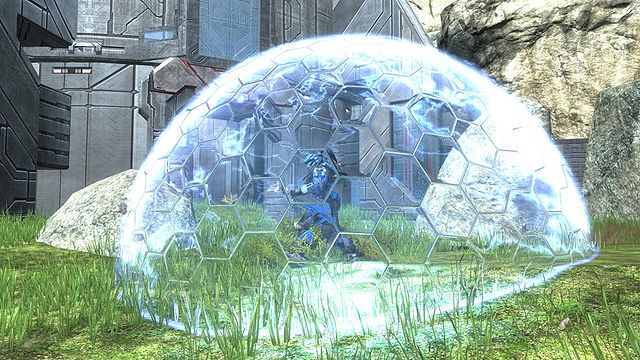


The Halo Reach Drop Shield.

Because someone looked at the Halo 3 Bubble Shield and Halo 3 Regenerator and thought, “Hey, these two kinda overlap in their intended roles. Why don't we COMBINE them?!”

It didn't take more than a week of post-launch matchmaking to find instances of players spawning with Bubbles breaking a gametype. Nothing like trying to play 4v4 Oddball where the entire game is centered around a nigh-impenetrable dome of safety. Oh, your Drop Shield expired? I gotchu fam.

I mentioned Bubble Shields could only be destroyed from inside. Drop Shield at least realized this mistake and allowed it to expire based off damage (more like the Deployable Cover).

In BTB, we saw Drop Shield used on Boardwalk one-sided objective to troll chain bubbles of immunity while running a flag home or running a bomb in.

We rarely saw the Drop Shield used to create a “field of safety” from vehicles out in the field (partially due to how overpowered Armor Lock was) – it was occasionally used for attempted flag steals on Hemorrhage for getting into a vehicle. But even then, it was too big of a trade off to give up on other armor abilities to maybe get a flag into a vehicle if you managed to make it to the base without being destroyed.

Before it was realized Warthogs were essentially useless, it was common for drivers to take Drop Shield in order to recover safely if the vehicle flipped. But that didn't last long.

In Drop Shield's case, it exhibited the problem of trying to take an on-map piece of equipment and translating it into a repeatable use ability for players, regardless of cooldown. It's also a problem I'll address in a later Audley's Workshop when I talk about Empire-Specific Rocket Launchers in PlanetSide 2 (scalability – balancing a tool available to one person versus the tool being used by GROUPS of people).

Before Drop Shield was ever given the green light by Halo Reach's design team, two questions should've been asked:
  • For what reason should a player take this ability over the others?
  • What will happen if this ability is in the hands of every player?

After both of those were asked, chances are its problems would've been a bit clearer prior to its release to the general public.

And, as with the case of the Bubble Shield, it probably would've been realized that the Drop Shield had no true purpose belonging in Big Team Battle. In cases where the shield is being deployed to survive in the open field, are players ever actually advancing, or just delaying? In cases where the shield is being deployed to protect an objective, is there actual counter-play available with other abilities or who haven't gone out of their way to pick up a Plasma Pistol.

But rather than outright remove the Drop Shield... let's make it into something that can work in Halo.

The main issue, in my eyes, is the area of survivability is limited to where you cast the ability. So before we move further, let's change the name. Drop Shield is now Safeguard.

When Safeguard is cast, a somewhat small (half/a third of the size of normal Drop Shield Bubble) semi-transparent sphere is created around the player. The player who cast Safeguard may still use their weapons freely. However, any foreign bullets, projectiles, etc. that come into contact with the sphere have their damage reduced substantially (by ~80%) and transferred to the player whose sphere they have come into contact with. This sphere moves with the player as the player moves.

The sphere could also be given stages of damage like Reach vehicles, causing the bubble to shrink in size (with both damage and duration rapidly causing stage transitions) and decreasing the amount of damage mitigation from the sphere.

Now you've taken an immobile shield without much purpose outside of protecting an objective and turned it into a selfish defensive mechanism for turning a player temporarily into a pseudotank (still able to be killed), at the expense of being an easier target to hit.

This new form would encourage pushing across open terrain, aggressive flanks or engagements, and prevent players from stacking their shields as a sort of Road to Glory for flag or Permanent Thunderdome for Oddball. Players wishing to use Safeguard to protect teammates would be forced to actively use their bodies to shield their teammates.

Suddenly you've turned Drop Shield into a more active ability with more incentive for aggressive use and less room for abuse cases.


And my work here is done. Until next time, folks!

Monday, May 25, 2015

Audley's Workshop: Balancing an FPS Sandbox


A while back, I did a blog on having certain weapons appeal to multiple playstyles, referring to the horribly vague MtG archetypes Timmy/Johnny/Spike to label the players to whom those weapons would appeal.  It focused on having weapons in Halo be both fun and competitively viable.  I mentioned the Halo Reach Grenade Launcher as the pinnacle of success for designing weapons for all players, then pointed out three examples of weapons that appealed to two archetypes and failed to meet the standards for the third.

Today, I'm revisiting Audley's Workshop with a focus on tweaking some weapons from the Halo series to make them more viable competitively or more appealing to the broader player base.  There won't be any focus on Timmy/Johnny/Spike here, just strictly on some weapons that get overlooked in Halo for either being shoved too far into a niche, being too unreliable, or simply not having enough identity on their own to be embraced by the players.


The Needler.  Everyone knows the pink mist.  Or, in a strafe battle, the pink missed.

Halo 3 and Halo 4 had decent incarnations of the weapon, but even then its niche was very difficult to abuse and relied heavily on flanking and catching players by surprise in order to get kills with.  By the time a player had time to turn and react to the first needle connecting in H3, the others were already locked on and tracking to set up the super combine.

But as we move into Halo 5, where the Thruster is readily available, and players are going to be able to quickly break those lock-ons, how does one make the Needler more useful?  Hell, the weapon already had trouble keeping up with any side-to-side motion, whether strafing or simply running in a straight line perpendicular to the wielder... so where is the Needler missing power?

While you may think, "Hey, the Needler's tracking could just be improved to make it harder to dodge!" -- reducing counterplay isn't a wise decision for a weapon that is theoretically a very fast kill weapon between time-of-engagement to time-of-death.  While the actual travel time of the needles makes the kill time long, the actual time to react from being shot is substantially smaller.  Reducing post-reaction counterplay is not the way to go.

"Well then Audley, I guess you have an idea?"  I do, and I've mentioned it on forums in the past.  You know what weapon the Covenant never had a true successor to in Halo, despite having plenty of CQB weapons?  The shotgun.  What if, instead of a standard melee, using the melee with the Needler unleashed all of your needles in a uniform cone ahead of you?  If seven, or eight, or whatever the arbitrarily chosen supercombine number happens to be managed to lodge themselves in the target, you get the insta-kill as usual.  Suddenly the Needler is a much better weapon in CQB, which immediately improves its definition in the sandbox.

This also improves the Needler's options versus a player running perpendicular to you; instead of simply praying the tracking decides to work at your range, you lead your shot and unleash.  If they aren't terribly far away, and you angle your shot (melee) correctly, enough needles will land in their side to score a medium range kill with the Needler.  (Audio cues will be necessary for this "MULTIPLE NEEDLES INBOUND" situation though.)

Voila, the Needler is now the best weapon in Halo history.  You're welcome, Bung343.


Oh, nice, the Plasma Rifle.  A weapon that gets praised in Halo: CE for fitting well into the sandbox with its hitstun and quick camo uses.  Hardy LeBel did a wonderful job with this gun and making it useful in Hal-oh, wait, you're telling me outside of HCE no one uses the Plasma Rifle?  Because it's a shit generic automatic weapon with no niche or role at all?

Well, we need to fix that!  No weapon should be useless.  Let's talk about how to make it better, without treading down roads been walked before, such as the hitstun method which limits counterplay potential.

As a visible projectile-based automatic weapon, the Plasma Rifle is a weird beast.  Players can literally dodge the shots (unlike the hitscan incarnations of the Assault Rifle) and see where they need to move in order to stay ahead of their opponent's reticule.  This is good, it offers counterplay.  The slower projectile speed compared to most weapons in the game makes it difficult to use.  It leaves us with an unreliable weapon, especially at longer ranges.

In non-Combat Evolved Halo games where the Plasma Rifle is available to be used, its most common role is for a quick couple of shots followed by a melee.  A pretty shitty niche as other CQB/melee weapons outshine it in that role, and other automatics (SMG/AR) outshine it in gun roles.  As a gun, the Plasma Rifle is pretty shit.  Its other common use, in H2A's case, is to put a couple of shots in, back down into cover while you switch to your BR, and finish with a headshot.  A role where it is outshined by a Plasma Pistol (outside of Warlord, where there is no PP).  Uh oh, looks like we have a weapon that isn't very useful in its intended niche.

So how do we make the Plasma Rifle more reliable at range, or stronger as an automatic?  How about we do both at once -- by removing the limitation that each shot fired only has one particle, instead splitting it into two?  To make the weapon more effective at range, the plasma could feature a dissipation effect -- where the plasma spreads out, becoming able to hit a wider area at range.  This would still have significant damage versus shields, but be relatively useless versus player health.  The damage would still degrade at range based off how much of the spreading disc of plasma hit the player, but the focus here is to soften shields.  The second part of the damage would remain in the center of the disc, increasing focus on hitting your shots accurately as a player gets low on health (in line with Halo's core combat philosophy across the series where you body shot until a player is low/out of shields), then headshot.  The central portion of the Plasma Rifle's bolt could convey headshot bonuses, as well as pack a substantial punch to health any time it connects to an unshielded player.

Suddenly you've got a weapon with nuance for use (do I focus on aiming accurately or just try to drop shields as best as I can, do I have teammate help?) while it still has potential to stand on its own as an automatic, due to having a centralized point of increased damage for penetrating health and finishing off players that have had their shields dropped by the high energy plasma.

But let's not stop there; I've only been talking in 4v4 so far, there's another niche the Plasma Rifle was absolutely overshadowed by its UNSC counterparts...in BTB, versus vehicle health.

It makes zero sense to me that UNSC vehicles are so resistant to plasma damage.  That shit should shred the fuck out of vehicle health.  C'mon now.  Bump up the UNSC vehicle health damage from Plasma-based weaponry.  UNSC vehicles are built to withstand other UNSC vehicles' weaponry, not Covenant weaponry.  UNSC ARs/Magnums/Rifles should not be stronger against vehicles (outside of rifles versus weak points) than Plasma Rifles.

Okay, now we've buffed the Plasma Rifle to viability.  Who are we looking at now?


I'm afraid I don't recognize that weapon.  I don't think I've ever seen anyone use it.  What is it?

Oh, that's the Carbine?  I thought that thing was just a myth made up by those bastards that played playlists as Dinos and ran around shouting "wort wort wort" to be funny.

Here we have an example of a weapon that is perfectly capable in its own right (usually, I think in H3/H4 they intentionally made it weaker than the other options just so they'd never have to bother worrying about it.) but which rarely gets used apart from a pick-up to hold as a sidearm in case you run out of ammo in a power position you don't want to leave.

The Carbine has no role of its own, it's simply the "harder to use Covenant BR"; I say harder to use because it's single shot, versus the BR's burst.  Mistakes are punished more, and it's high shots-to-kill leave plenty of room for mistakes.

So how do we give this thing a role?  Sage Merrill had a pretty good idea once.


But if this blog is to jerk myself off--err, challenge my own design mind, I need to explore a different avenue.  One that doesn't involve "oh just aim for the body if you can't aim and you'll get a flashy kill; it'll be sweet I swear."

First let's examine the canonical design of the Type-51 Carbine.  By design, it is meant to be a riflesque version of the Type-33 Light Anti Armor Weapon...also known as the Fuel Rod Gun.  The Carbine literally fires supersonic radioactive projectiles at the target.  It's most often wielded in campaign by Jackals, the "snipers" of the Covenant military.

So using this knowledge, what can we do to the weapon to give it some identity?  Looking at its Big Sister counterpart, the Fuel Rod Gun, we know that the fuel rod "deploys" after being fired a certain range -- making it move much slower and explode upon the next target it hits.  Thinking about this, Carbines could do the same after a certain range.  Within their intended range (max red reticule range or whatever) they could still fire the standard method that ultimately operate like any other rifle in the game, but as you extend beyond that range, the fuel rod "decays" turning the bolt into an explosive projectile.  This could make it useful for pinging targets behind cover in long range skirmishes, damaging light vehicles as they attempt to flee, or packing an extra punch against smug DMR wielders who think their superior range gives them safety.

Ultimately, this change gives the Carbine a unique role as a dual-threat weapon; a rifle in standard ranges with some potential for splash damage or anti-armor potential in extreme ranges (hello BTB crowd!).  Suddenly the weapon has flavor that allows it to stand out from the other weapons of its niche, and you may actually remember it exists!  (And hey, making the Covenant Rifle explosive isn't that farfetched, we DID have a Supercombining Needle Rifle.)  And for those of you who can't visualize how I imagine the longer-ranged Carbine bolts to work...just imagine the Phoenix from Perfect Dark.

One last Halo weapon before I delve into my "bonus" topics...


"Audley, I didn't play Halo 4.  What the fuck is that?"

Don't worry, it's not a morning star.  It's the Pulse Grenade.

I encountered a poll on GameFAQs asking what the most useless weapon in Halo 4 was, and the #1 answer, with 40% of the vote (passing the Suppressor, Storm Rifle, and the Gravity Hammer) was the Pulse Grenade.

In my experience, this wasn't true.  Melee+Grenade throw was an instant kill with Pulse Grenades active...sharing this knowledge even convinced Eric "Gh057Ayame" Hewitt to include Pulse Grenades on-map in his Team Throwdown settings which were used for competitive tournaments during H4's lifespan.

So, if I'm so convinced Pulse Grenades were one of the strongest CQB weapons in all of Halo 4...why do I feel the need to talk about them?  It's all about player perception.

When you see the Pulse Grenade's animation, and its name, you expect it to be a sort of delayed-explosion that deals a ton of damage.  In reality, the Pulse Grenade's damage is front-loaded.  It takes place instantly in the giant circle of doom you create.  Add in Halo 3's Power Drain animation to a player's knowledge base, and you expect the Pulse Grenade's giant orange doomglobe do also deal significant damage over time.  Nope, not the case.

Literally the only good uses for the Pulse Grenade were to finish off players who were severely weakened -- the delayed effects were negligible at best and completely avoidable at worst.  But the instant burst of a well-thrown pulse grenade (or, in the primary usecase, a pulse grenade thrown at your feet immediately after a melee) was unavoidable, and made the pulse grenade a potent option as a finishing tool.

So, to reiterate clearly after all that jumbled rambling...

The Pulse Grenade needed nothing more than an animation fix to better clarify it's purpose to the users.  It was an instant burst tool, not a delayed-damage like most grenades, nor an AoE drain like the Halo series' past tool, the Power Drain, which carried a similar animation.  Clarity of design is just as important as unique flavor and potency, otherwise your users simply won't grasp how good it actually is.


That's all for my Halo weapons to rework...Now for two bonus guns.

Perfect Dark - Reaper.

OH DEAR GOD THIS THING WAS A MONSTER.  Viscerally, it was one of the most fun weapons to use in the history of FPS.  But in terms of viability...dear god, the weapon was ass.  It wasn't really intended to be a serious use weapon from what I can gather; hell, in game canon terms, humans aren't even supposed to be able to wield it, only the Skedar are.

If you didn't play Perfect Dark and are wondering what the fuck a Reaper is...  Imagine you took the bottom of a blender or food processor and made it the size of a chainsaw.  So you have a giant rotating fan-o-death that can shred people to death.  Got that in your mind?  Okay, that's just the SECONDARY fire mode of the Reaper.

Now imagine, for the primary mode...  That each of the tips of the "fan blades" can fire bullets, and as the fan spins faster, your rotating death fan of doom and despair fires faster as well, and is essentially the fastest firing machine gun in the history of anything ever.

Got it?  That's the Reaper.  Don't got it?  Here's a video.


With great fire rate comes great inaccuracy.  Dear lord the thing was inaccurate.  Unwieldy.  The melee secondary fire mode was fun, but mostly useless unless you had a really good corner to hide in for ambushes.

In terms of fun factor, the Reaper was fantastic.  It was a weapon you'd pick up just to watch it spin as you were hypnotized by murderous glee.  Unfortunately, there was just no way to reconcile its RoF with its accuracy to make it work for players...or was there?

The Reaper's kill time was surprisingly fast, when bullets actually hit.  Myself, I'm not a fan of randomly making bullets miss because you arbitrarily want to limit a gun's power.  Drastically reducing the damage per bullet and increasing the accuracy could've gone a long way to making the Reaper a bit less farfetched as a tool -- and as a cost for the increase in accuracy, tuning the recoil to actually RECOIL (rather than again, just being a random spread of bullet trajectories).  Alternately, taking the Halo "ripped-off-turret" approach of reducing the player's movement speed could also curb some of the power given back to the player by more consistency in the weapon itself.  A final route, though probably too ahead of the technology curve for Perfect Dark's day could've been to greatly increase the magazine size (from 200 to 1000) and add the potential for the gun to overheat as it approached its faster RPMs, leading a player to want to micromanage the heat and avoid spinning too fast.


And the final gun... Quite possibly the most hated gun in FPS history...


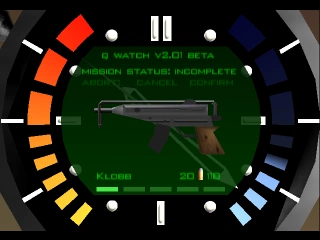
The Klobb.

How could this have been fixed?

Just delete the goddamn useless piece of shit.


That's all for my random blog on FPS sandbox design, hope you enjoyed.

Wednesday, September 4, 2013

Halo 4 Global Championships: When Marketing Campaigns play Dress-Up as eSports

Disclaimer: I want to make it absolutely clear that 343, the players, and the commentators were absolutely fantastic this weekend.  Nothing I'm about to say is directed toward any of those three groups unless I explicitly mention them in the statement.


So...how about those Halo 4 Global Championships?  They were pretty fantastic, right?

Audley Enough, it left a bitter taste in my mouth.

I saw some tweets about how it was a great tournament.  And here's where I'm going to stop you, and correct you.

That was an awful tournament.  It was a good show.  It was a good (expensive) marketing campaign.  But again, from a competitive integrity standpoint, that tournament was terrible.

First, the format.  A...100+ team FFA feed into a 4-player 1v1 BEST OF ONE finals?  The fuck is that?  Best of one?  Really?  Now, time constraints are one thing, but getting yourself so constrained that you have to limit yourself to best of ones for GRAND FINALS for (one of) the LARGEST PRIZE POOLS Halo has ever seen?  That's pretty fucked up.  Seriously.

FPS titles have traditionally been a showcase of multiple maps and sometimes multiple game variants.  Hell, even Quake Live, which still gets played at Dreamhack events has Best of 3 finals showing off three different maps.  And if you're unfamiliar, its format is always 1v1.

By my next statement I mean no offense to the winner, Aaron Elam...but when a player openly admits to only having practiced for an event for about a week prior and ends up winning Two HUNDRED THOUSAND dollars at said event over players who have put in substantially more time and effort...you know the format of the tournament is a little fucked.  Again, don't take this statement wrong.  Ace played fantastically and he earned his win...but as someone who preaches practice, I can't help but feel if there was a little bit more consistency required of the tournament, he may not have seen as great of success.  I still extend my congratulations to him.  Hey, he was the first Halo pro to have ever had me on his friend's list.  I can't hate.


Secondly, the trailers.

Okay, what the fuck.  This is a Halo tournament, right?  It's the HALO FOUR GLOBAL CHAMPIONSHIPS, right?

WHY THE FUCK ARE YOU SHOWING ME A FUCKING TRAILER FOR BATTLEFIELD 4 AND FUCKING PLANTS VERSUS ZOMBIES GARDEN WARFARE?  I don't go to LoL events and expect to see a trailer for DotA2.  You know why?  BECAUSE THEY FUCKING SHOW YOU LEAGUE OF LEGENDS at LEAGUE OF LEGENDS EVENTS.

For this to have been as marketing-focused as it was, I'm confused as fuck as to what Microsoft was actually trying to market.  I mean, they gave us some of the most limited scope of what Halo has to offer as humanly possible -- FFA and 1v1s of a team game... And then they go off and show us three trailers for three different shooters all coming to the XBox One console.  This event's about Halo, right?  So why are you trying to draw us to different shooters, Micro$oft?


Thirdly, the production.

Wait, the production?  Those production values were insane, Audley!  What are you smoking?

I'm not going to disagree that the production values were insane.  But the part that bugged me about it was how painfully scripted it was.  If you couldn't tell the two hosts were reading from a teleprompter, you weren't watching.  Granted, they would go off-script on occasion...but in those instances, it was the only time the two would actually engage each other or their surroundings during the show.  Otherwise, they just kept looking forward.  You could even feel when they felt the teleprompted jokes ("Spartan badassery") were too forced, and grit their teeth to grind through it.

I know Riot and the LCS use teleprompters, and often the casters read from it when setting up transitions.  However, most have enough genuine character of their own merit that it doesn't feel as awkward.


I do want to make it clear -- I enjoyed my time in Benaroya Hall during the finals.  It was a good show.  It was executed very well, and the games were intense and fun to watch.  But when I see people praising the event and lauding it as proof that "Halo is back!" and "343 gets it" I just shudder.

I repeat what I've said all along: Halo 4's launch state being poor isn't 343's fault.  That launch state is a publisher issue, not a developer one.  Publisher determines release date, and when something's released with no beta, tons of bugs, and missing content, you don't say "Oh, well clearly that's what the developer wanted.  What idiots."  That's a "Big Daddy Moneybags decided we had to release by this date or we wouldn't get paid."  Oh, and by the way... Microsoft Game Studios published Halo 4.

Also, how soon do you think an event that size will get done again?  Microsoft and Virgin gaming just spent hundreds of thousands of dollars for a tournam-err, excuse me, MARKETING CAMPAIGN, that had a couple months worth of qualifiers, weeks worth of headaches for the staff that had to moderate the online qualifiers (I honestly feel for Bravo and bsangel after seeing some of the tweets they got every time a loss or a leave happened during the Online quals.).  If they manage to do another one of these before PAX Prime of NEXT year, I'll be speechless.


Microsoft still hasn't shown that they understand eSports...neither from a format standpoint, nor from the standpoint of building storylines.  Hell, there wasn't TIME to build storylines with this mega-condensed faux-tourney they held this past weekend.  I don't even recall Bravo or Goldenboy mentioning that Ace's older brother happened to be at the Halo 4 GC as well (and, if you saw, ran onto stage to hug him when he won).

So for me, this was not an entirely reassuring experience.  It still shows a deep ignorance of competitive gaming from the corporate dogs at Microsoft and there's still miles of room for improvement in nearly every avenue.  I hope Microsoft takes a more serious approach to one of its most historically successful franchises and attempts to turn this into a more focused attempt to bring the series back to what it used to be, rather than an attempt to dump money onto a game whose fans are turning away from it in a half-assed attempt to bring them back to the game.  I sincerely hope the latter is not the case.


Anyway, in closing...  I want to thank 343, all of the players (even Gamesager), Goldenboy, Gh057Ayame, Microsoft, Virgin Gaming, and PAX Prime for enabling the Halo 4 Global Championships to happen.  It is a step...maybe not in the right direction, but at least in a less-wrong direction...toward bringing Halo back to the limelight.  And without all of their help combined, I wouldn't have had the opportunity to rant about it.

It was a great experience, and the finals were extremely tense.  Regardless of my gripes, I'm still elated that I went.  And I hope to see more in the future.  I leave you with photographic proof that "Halo is dad" though.  Gandhi and Maven casting Call of Duty: